UVB-76 / The Buzzer
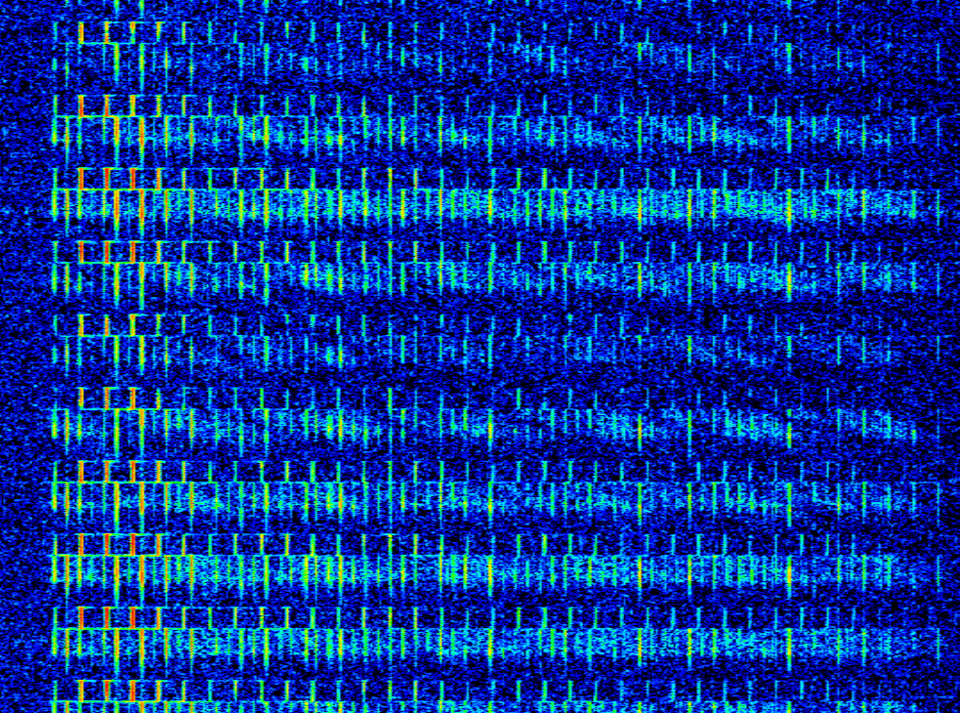
The 4625 kHz channel marker; ENIGMA S28
UVB-76 / The Buzzer in the timeline
The USSR tests RDS-1 ('First Lightning') at Semipalatinsk, ending the American nuclear monopoly earlier than Washington believed possible. The nuclear standoff that follows is why command-and-control radio networks, including the Buzzer's, exist at all.
For thirteen days the United States and the USSR stand at the edge of nuclear war over Soviet missiles in Cuba. The crisis, resolved on 28 October, drives both sides to build survivable command systems, the strategic anxiety behind the Perimeter myth that later attaches to the Buzzer.
A Soviet government decree orders the development of Perimeter, a system to guarantee nuclear retaliation even if the leadership is destroyed. Its most concrete component is a command missile that would fly over the country broadcasting launch orders by radio, a real 'dead hand', though not the one the Buzzer myth imagines.
At some point in the 1970s a monotonous signal settles onto 4625 kHz and stays there. No source in this archive dates its start; the earliest surviving recording is from 1982. Later called UVB-76, or the Buzzer, it will outlast the state that switched it on.
The earliest surviving recording of the signal on 4625 kHz dates from this year; the listening community credits it to the Dutch monitor Ary Boender, who has followed number stations since 1982. Decades later, through his 'Numbers & Oddities' column and logs, he is one of the community's steadiest chroniclers.
Lieutenant Colonel Stanislav Petrov, on duty at a Soviet early-warning centre, decides that a satellite report of incoming American missiles is a malfunction and does not pass it up the chain. He is right. The episode shows how thin the human margin was in the systems the Buzzer's myth invokes.
The Perimeter ('Dead Hand') system is declared operational. It is semi-automatic, with human duty officers in the loop, monitoring seismic, light, radiation and pressure sensors for signs of a nuclear strike, a system endlessly and wrongly conflated with the Buzzer on 4625 kHz.
East Germany opens its borders and the Wall falls. Within two years the Warsaw Pact and the Soviet Union will be gone, but the Buzzer keeps buzzing.
Boender begins his long-running 'Numbers & Oddities' newsletter and logs, cataloguing the strange utility signals, buzzers, pips, geese and squeaky wheels, that share the shortwave bands with the spoken number groups.
Pleikys becomes Lithuania's Minister of Communications and Informatics, an office he holds until 1998, and in 1998 publishes 'Jamming', a detailed study of how the Soviet Union tried to smother foreign broadcasts.
Monitors report that on Christmas Eve 1997 the Buzzer was interrupted by a live male voice identifying the station as UVB-76 and reading a short number group with a spelled code word. The account circulates in the listening community; no source held in this archive documents the exact time or wording. It is the origin of the station's famous, mis-transcribed name.
Yarynich publishes 'C3: Nuclear Command, Control, Cooperation', arguing for transparency between the nuclear powers about their command systems, the opposite of the secrecy that breeds myths like the one attached to the Buzzer.
The sober explanation of the Buzzer is not a doomsday trigger but a military channel marker, keeping a frequency occupied and confirming that receiving operators are awake. It is the interpretation most monitors now accept and the one priyom.org sets out in detail; no first date and no single author for it can be documented.
Russia fights Georgia over South Ossetia and Abkhazia, its first European war of the 21st century. Buzzer activity is watched for signs of mobilisation, though no clear link is ever proven.
Pieter-Tjerk de Boer writes the software behind the first WebSDR at the University of Twente, a shortwave receiver anyone can tune through a web browser. The receiver was set up at the university radio club at the end of 2007 and announced publicly in April 2008; the club ETGD runs it. Suddenly the Buzzer is listenable from a phone in Sao Paulo or Seoul.
Journalist David E. Hoffman publishes 'The Dead Hand', a history of the late Cold War arms race built on interviews with insiders. It documents the real Perimeter system in detail.
Journalist Nicholas Thompson publishes a Wired feature revealing the Perimeter system to a mass American audience, drawing on Yarynich. The article cements 'Dead Hand' in popular imagination.