Perimeter ('Dead Hand')
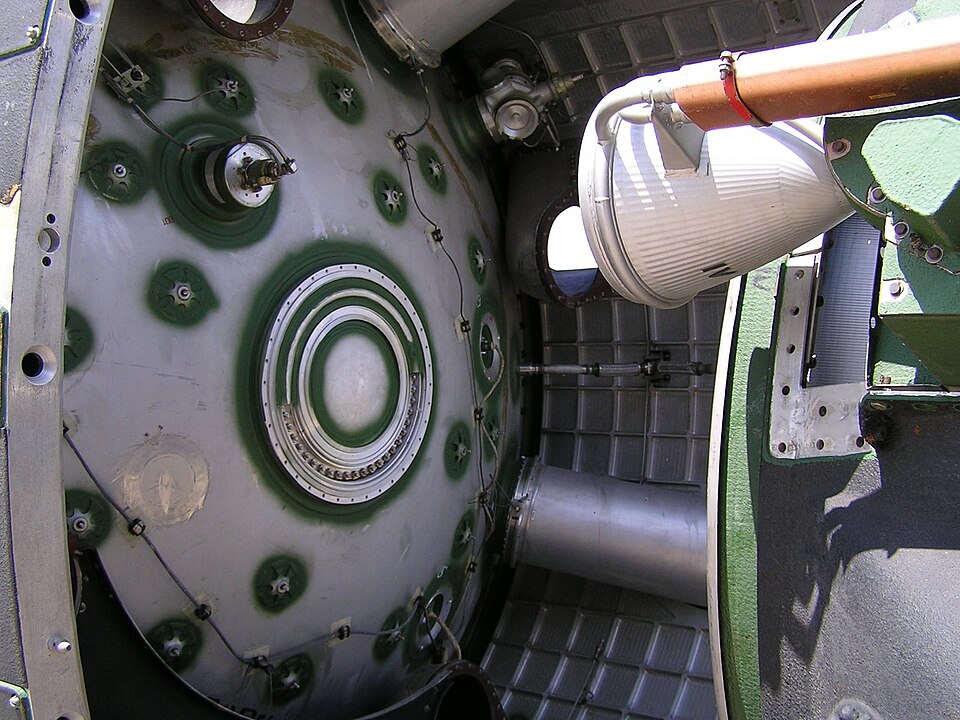
Semi-automatic nuclear retaliation system
Perimeter ('Dead Hand') in the timeline
The United States drops atomic bombs on Hiroshima (6 August) and Nagasaki (9 August), the only wartime use of nuclear weapons. The blast, light and pressure signatures of a nuclear detonation will, forty years later, become the sensor logic of the Soviet Perimeter system.
Rocket designer Mikhail Yangel takes charge of a new design bureau at Dnipropetrovsk, Yuzhnoye, which becomes one of the Soviet Union's principal missile design bureaux. Decades later it will build the command missile at the heart of the Perimeter system.
For thirteen days the United States and the USSR stand at the edge of nuclear war over Soviet missiles in Cuba. The crisis, resolved on 28 October, drives both sides to build survivable command systems, the strategic anxiety behind the Perimeter myth that later attaches to the Buzzer.
A Soviet government decree orders the development of Perimeter, a system to guarantee nuclear retaliation even if the leadership is destroyed. Its most concrete component is a command missile that would fly over the country broadcasting launch orders by radio, a real 'dead hand', though not the one the Buzzer myth imagines.
The Yuzhnoye bureau's command missile, a rocket carrying a radio transmitter instead of a warhead, makes its first successful flight test at Baikonur. In a test series running to March 1982 the concept is proven: a missile that shouts the order to fire to every silo still standing.
A realistic NATO nuclear-release exercise is partly mistaken by Soviet leadership for genuine first-strike preparation. Retrospectively recognised as one of the closest brushes with nuclear war, it is the atmosphere in which Perimeter was being finalised.
Colonel Valery Yarynich, a career Strategic Rocket Forces officer, is serving as a command-and-control specialist in the Strategic Rocket Forces as the Perimeter retaliation system is finalised. He knows how it actually works, the sensors, the logic, the command missile.
The Perimeter ('Dead Hand') system is declared operational. It is semi-automatic, with human duty officers in the loop, monitoring seismic, light, radiation and pressure sensors for signs of a nuclear strike, a system endlessly and wrongly conflated with the Buzzer on 4625 kHz.
From 1993 key details of Perimeter become public through the American nuclear-security expert Bruce Blair, and Yarynich begins to speak about the system openly, later also to journalists and historians. Almost everything the outside world reliably knows about the 'Dead Hand' traces back to him.
Journalist David E. Hoffman publishes 'The Dead Hand', a history of the late Cold War arms race built on interviews with insiders. It documents the real Perimeter system in detail.
Journalist Nicholas Thompson publishes a Wired feature revealing the Perimeter system to a mass American audience, drawing on Yarynich. The article cements 'Dead Hand' in popular imagination.
A senior Strategic Rocket Forces commander publicly confirms that the Perimeter system exists and remains on duty. The real 'Dead Hand' is acknowledged, even as the myth conflating it with the Buzzer refuses to die. Soviet accounts were never unanimous: General Danilevich told American interviewers that fully automatic launch systems had been rejected as too dangerous and unreliable.
This object is named in 13 verified source entries across 5 dossiers of this book. The entries sit with the people who built or used it, which is where the research recorded them.