Duga radar (Woodpecker)
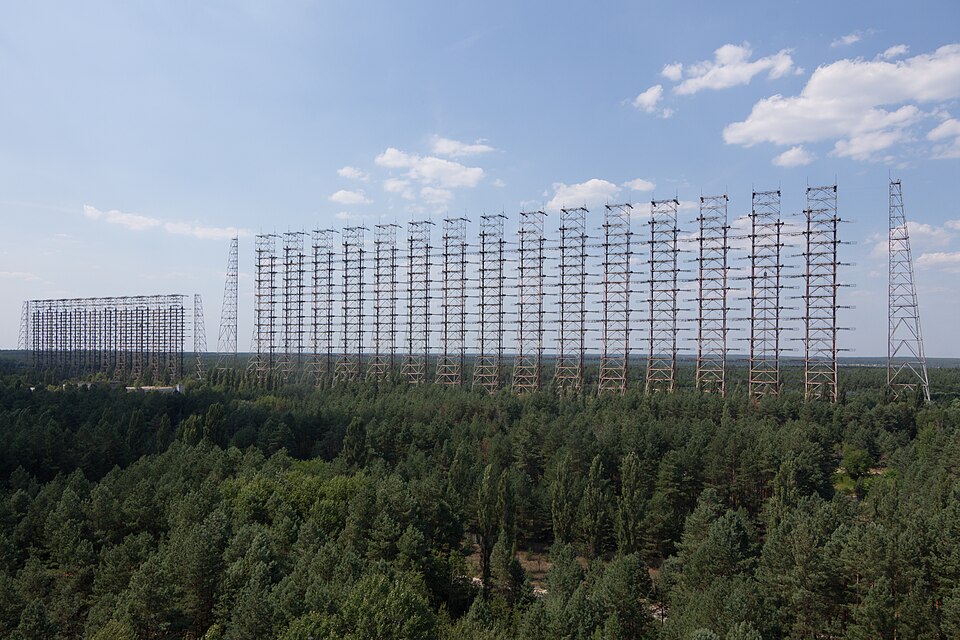
Soviet over-the-horizon radar
Duga radar (Woodpecker) in the timeline
The only biography found for him gives 3 November 1922. Franz Aleksandrovich Kuzminsky is born in the village of Pokotylove. He will become one of the Soviet Union's leading radar designers.
Kotelnikov leads Soviet radar ranging of Venus from 1961 to 1964, and later the radar mapping of the planet in 1983 and 1984, bouncing radio pulses off another planet and reading the faint echo, a triumph of the same signal-in-noise science that underlies both radar and the decoding of a distant numbers station.
Kuzminsky becomes chief designer of the over-the-horizon radar programme at NIIDAR, the institute for long-distance radio communications, and turns to the problem of seeing beyond the horizon, detecting a missile launch by the radar echo bounced off the ionosphere.
Under Kuzminsky's leadership NIIDAR completes the outline design of the Duga (5N32) over-the-horizon radar and builds the experimental station that detects Baikonur launches at 2,500 km. He becomes NIIDAR's director in 1975.
A Soviet decree approves construction of the operational Duga over-the-horizon radar after the success of the experimental station. Transmitter and receiver will be built some distance apart near Chernobyl, a colossus of steel that will haunt the shortwave bands.
The Duga over-the-horizon radar at Chernobyl-2 enters trial operation, accepted into service only in 1985, and a powerful tapping signal begins interfering with shortwave, aviation and amateur radio worldwide. Listeners nickname it the 'Russian Woodpecker'; governments file thousands of complaints.
A second Duga radar is built near Komsomolsk-on-Amur in the Soviet Far East, aimed across the Pacific to cover the blind spots of the western system. Two vast arrays now watch the sky for the flare of a missile launch.
Reactor No. 4 at Chernobyl explodes, the worst nuclear accident in history. A few kilometres away stands Chernobyl-2, the giant receiving array of the Duga over-the-horizon radar, the 'Russian Woodpecker', now inside the exclusion zone.
The Duga radar signal disappears from the shortwave bands. With satellite early-warning maturing and the Cold War ending, the enormous antenna arrays at Chernobyl-2 and Komsomolsk-on-Amur are abandoned, the Chernobyl array left standing inside the exclusion zone as a rusting monument.
Kotelnikov dies in Moscow at 96, honoured as a founder of Soviet radio science, radar astronomy and information theory, the East's answer to Shannon.
Research notes for this file are collected in the blog archive. All blog posts
This object is named in 1 verified source entry across 1 dossier of this book. The entries sit with the people who built or used it, which is where the research recorded them.