The machine itself
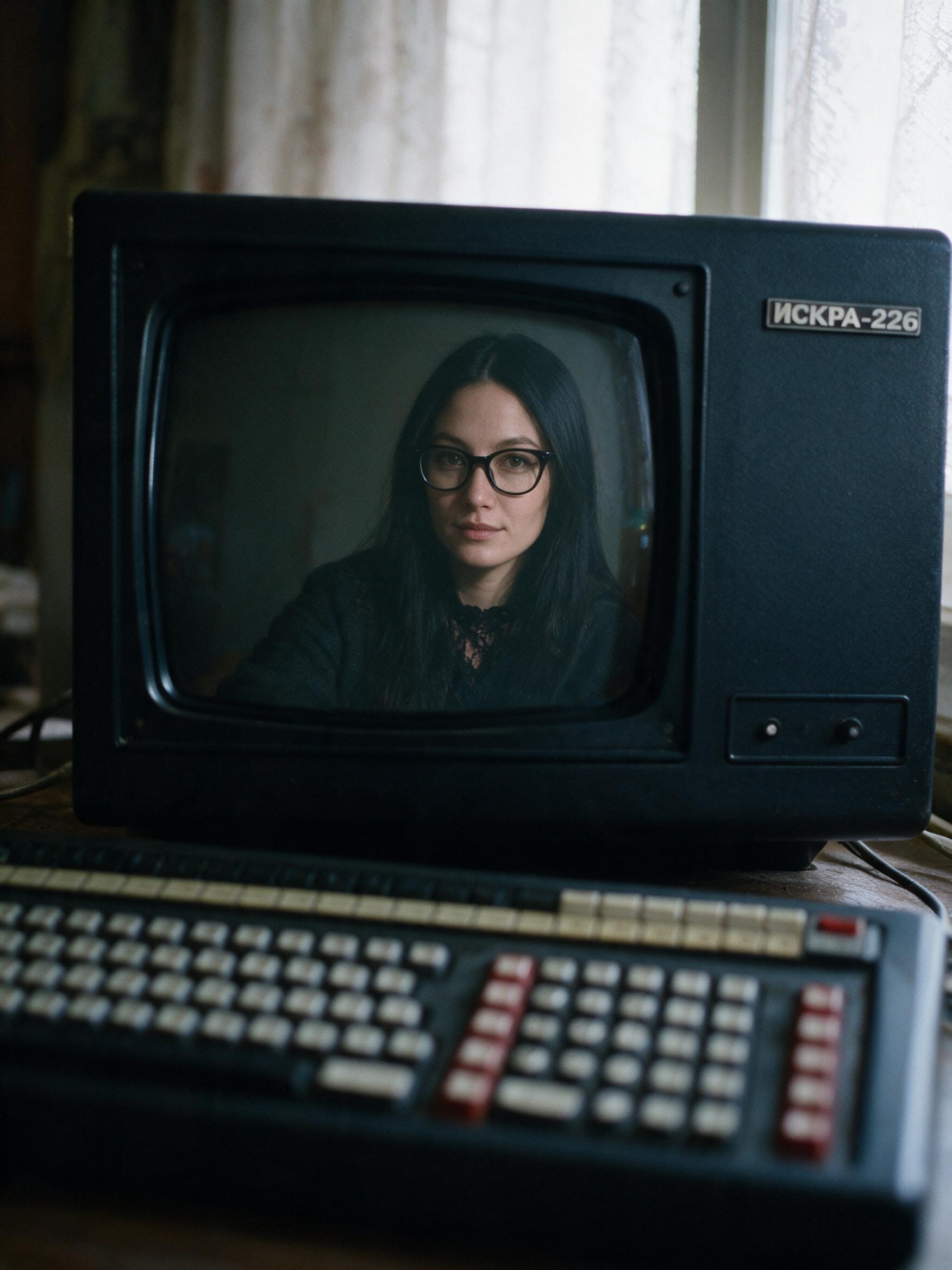
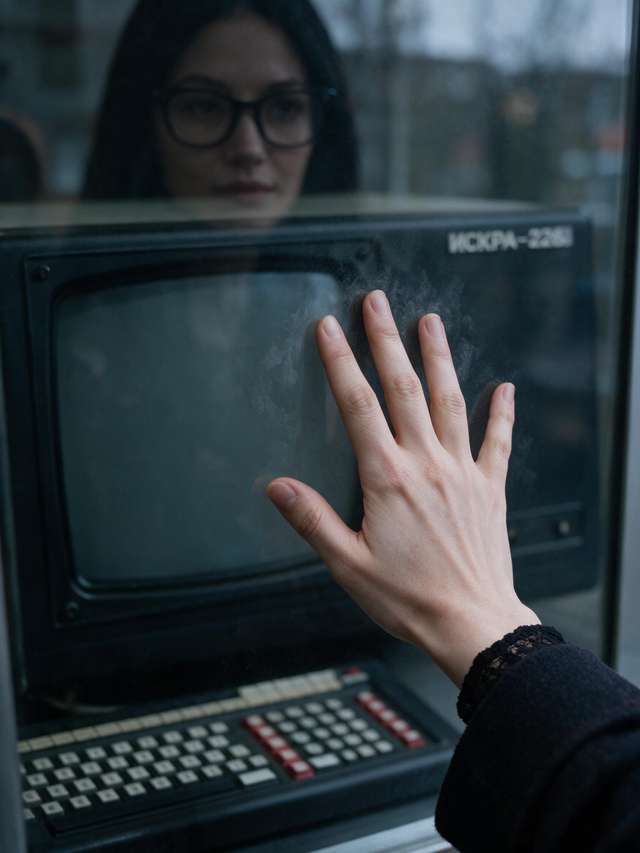
Программоуправляемая электронная клавишная вычислительная машина «Искра-226»
Two cities made this thing. Drawn up in Leningrad between 1974 and 1978, built in Kursk from the beginning of the eighties, and by 1985 more than eight hundred ministries and departments had one standing on a desk. What is left of it is six disk sides, a short shelf of books, one chief designer's name, and a price that ran to years of an average wage.
- designed
- ГСКТБ «Счётмаш», Leningrad, 1974 to 1978
- chief designer
- V. E. Kuznetsov
- built
- ПО «Счётмаш», Kursk, series from 1980/81
- type designation
- ТУ 25-01.1206-81
- processor
- 16 bit, built from K589 bit slices, twelve boards
- speed
- 500,000 to 600,000 operations a second
- ОЗУ, working store
- 64 KB, 128 KB in later builds
- УП, control store
- 64 KB, takes the interpreter off a disk at power on
- ПЗУ
- 8, 16 or 24 KB, the sources disagree
- ПМК, microcode store
- 2K words of 16 bit
- screen
- 80 x 24 characters, KOI-8
- graphics plane
- 512 x 256, one source says 560 x 256
- keyboard
- 110 keys
- disks
- 8 inch, 256 bytes a sector
- price
- 11,000 to 25,000 roubles by configuration
- in service by 1985
- more than 800 ministries and departments
Leningrad, then Kursk
The official account starts in 1974, with the Institute of Electrochemistry of the Academy of Sciences and the design office of the Leningrad Electromechanical Works, and a brief to automate the desk of a researcher who runs experiments. The drawing work sat at the Leningrad ГСКТБ «Счётмаш» under Valentin Yevgenyevich Kuznetsov, who had led the Iskra-125 and the Iskra-1256 in the same building from 1970 to 1978. Series production began at the Kursk works of the same name in 1980 or 1981, depending on which source you take, under the Ministry of Instrument Making. Pravda announced it on 11 May 1981 and mentioned without any embarrassment that parts came from East Germany, Poland and Bulgaria.
The first machines went to the Academy of Sciences and to Gosplan, and by 1985 more than eight hundred ministries and departments were working on them. That year a group of developers and managers, V. I. Shuteev and F. A. Bubalo among them, took the State Prize of the USSR for the family of computing complexes built around it; Academician Velikhov put the nomination in. The technical conditions call the object a program controlled electronic keyboard computing machine, which is a mouthful and tells you exactly what it was for. A desk, a person, a keyboard, and no queue at a machine room door.
Not a clone of the Wang, whatever the encyclopedias say
Around two thousand Wang 2200 desktops had gone into the USSR and Eastern Europe during the seventies and had become the planner's workstation. The familiar story is that COCOM cut the supply after Afghanistan and that Kursk took the last one apart to see how it worked. The dates refuse to line up: design started in 1978, the series in 1980, and the war in December 1979. Russian historians offer a different motive, a fear of what might be sitting inside imported hardware, and that one is a story too. I would not put my weight on either of them.
What is certain is the inside. The Wang ran its arithmetic on 74181 parts. The Iskra ran K589 bit slices, Soviet copies of the Intel 3000 family, on a processor spread across twelve boards. The English Wikipedia calls it a hundred percent binary compatible clone; it was nothing of the kind. The goal was full program compatibility, what was reached was partial compatibility at the BASIC level, and an interpreter for a machine with a completely different inside has to be written rather than copied.
Then it went past its model in the places the model would not go: a statement that opened the microprogram level to whoever asked, a graphics plane laid over the text, two fast serial lines, an instrument bus for laboratory equipment. Wang kept its microcode shut and told nobody how it worked. Kursk left the door off the hinges and put the assembler in the manual.
The numbers, and where they stop
The read only memory is the honest failure of this page. One source says 8 KB, the Balasanian manual says 16, and the 1989 equipment catalog says 24 for the full build, and I am not going to quietly pick the one that reads best. Underneath it lies a second store that gets confused with it constantly. The ПМК holds 2K words of sixteen bits rather than 2 KB of bytes, the real bit slice microcode lives there, and no dump of it exists anywhere I can reach. Everything I know about how this processor actually works stops at that line.
The price ran between eleven and twenty five thousand roubles depending on the configuration. An average monthly wage in 1988 was about two hundred and twenty, and a Zhiguli was seven to nine thousand, so the object on the desk cost somewhere between one and a half cars and three and a half. The payroll software I recovered from one of these disks was moving sums of thirty to ninety roubles for teenagers on work placement, calculated to the kopek and reconciled against a cash desk under two signatures. Nobody who sat at one of these owned it. Everything it counted was smaller than itself.
Who is on it, and who is not
Every designer, laureate and works director with a name attached to this machine is a man. Kuznetsov drew it, Shuteev and Bubalo took the prize, the Kursk plant had directors and they are on record. The plant finished its first Feliks adding machine deliberately on 8 March 1948, International Women's Day, and made that its founding date. Not one woman from that shop floor has a name in anything I have read.
Go to the printed literature and the pattern turns over. One query on one Russian library catalog returns at least nine women, and every one of them is writing the machine down rather than building it. Markelova wrote the operating manual of 1987. Kormilitsina co-wrote the first introduction for beginners. Sokolova co-wrote the guidance for teaching with it. Krasnoproshina co-wrote the book on designing software for it. Vertenova and Silina co-wrote a Leningrad preprint on an interactive programming system. Mukhina wrote part two of a manual by herself. Zhilkina led a set of methodological recommendations on working time records. Kuznetsova co-wrote the recommendations for the text processing variant.
Nine is not a total and I will not let it become one. It came out of a single catalog and a single title search, so it is a floor with nothing standing on it, and the argument was never arithmetic. The argument is the division of the work. The men who made this machine are named as makers, and the women who are named at all are named for writing it down. The one place that division comes apart is not in a catalog at all, it is in the bytes: L. V. Muchkina stands in the banner of the 1989 payroll software beside Gorenburgov and Vintskevich, as one of the three people who wrote the thing that paid the students.
Two more sit at the edge of this and I would rather leave them in the open than tidy them away. The first is a single booklet of fifty three pages. The second BASIC course from the railway institute was written by a man and reviewed by A. R. Rotenberg and G. A. Sheikina, and its last page names an editor, a technical editor and a proofreader, all three women, on a print run of three hundred copies given away free. One page holds both halves of the pattern at once.
The second is thinner and I want it stated as thin. One of the two digital copies of the Balasanian book in my repository carries the name Zelenova in the author field of its file properties, next to a title field that still reads like a Word document from somebody's desk. That field records who made the file, not who wrote the book, and with no initials on it there is nothing to attach a person to. It is a name in the properties of a document. I write it down because it is there, and for no other reason.
What is on the shelf
Seven files sit in my repository under docs, four hundred and eighty one pages of Iskra material and fourteen more of something else, and until this page none of them was linked from anywhere. There is Aladiev's architecture reference from Kiev, the Balasanian programming book from Moscow, two thin methodical booklets from the railway institute, and a bundle of photographed factory paper: a block passport from 1982, hand drawn schematics, the keyboard interface with its РУС/ЛАТ switch inked in by somebody's hand. Between them they are the only reason the emulator exists. The instruction encodings came out of section 1.4 of Aladiev, read as page images at 200 dots per inch, because no text of that book has ever been made.
Two of the seven are the same book twice over. Both run to 171 pages, both carry the same thirty five figures and the same half million characters, and every page of one renders identically to its twin. What differs is the file properties: one save from 2014 with the original Russian fields on it, one from 2020 with English cataloging laid over them. I list the book once and name the second file underneath it, because the same volume standing twice does not make a longer shelf.
The fourteen pages that are not an Iskra manual at all are an Intel datasheet from 1975, for the 3001 microprogram control unit. It earns its place for one reason. The K589 parts this processor is built from are Soviet copies of that Intel family, and this sheet is the only English description of the layer where the machine goes dark on me. It documents the Intel part. It does not document the Iskra, and I cannot show you that any Iskra board carries the Soviet copy of this particular chip.
The people
- V. E. Kuznetsov Валентин Евгеньевич Кузнецов
- Chief designer Led the Iskra-125 and Iskra-1256 developments at ГСКТБ «Счётмаш» in Leningrad from 1970 to 1978, then the Iskra-226. Russian Wikipedia, «Главный конструктор машины»
- V. I. Shuteev and F. A. Bubalo В. И. Шутеев, Ф. А. Бубало
- State Prize of the USSR, 1985 Named in the collective awarded the prize for the family of problem oriented computing complexes built on the Iskra-226. Academician Velikhov put the nomination in. Russian Wikipedia; Judy and Clough, Advances in Computers vol. 29
- L. N. Markelova Маркелова Любовь Николаевна
- Author, operating manual Ekspluatatsiya programmoupravlyaemoy vychislitel'noy mashiny "Iskra-226", Moscow: Mashinostroenie, 1987, 223 pages, for training and retraining staff to program the machine. Russian State Library 01001378317
- N. N. Kormilitsina Кормилицина Наталья Николаевна
- Co-author, introductory course Pervoe znakomstvo s personal'noy EVM "Iskra-226", Leningrad: IPK SP, 1986, 27 pages. Russian State Library 01011079387, MARC 700
- A. V. Sokolova Соколова Анна Витальевна
- Co-author, teaching guidance Metodicheskie ukazaniya k ispol'zovaniyu mikro-EVM "Iskra-1256" i "Iskra-226" v uchebnom protsesse, Moscow: MTILP, 1985, 35 pages. Russian State Library 01013968120, MARC 700
- A. A. Krasnoproshina Краснопрошина А. А.
- Co-author, software design Proektirovanie programmnogo obespecheniya personal'noy EVM Iskra-226, Kiev: Tekhnika, 1989, 254 pages. Russian State Library 01001461868, MARC 700. The book's own colophon prints the patronymic differently from the authority record, so the initials stand.
- N. N. Vertenova Вертенова Н. Н.
- Co-author, interactive programming system FOS: interaktivnaya sistema programmirovaniya dlya EVM "Iskra 226", Leningrad: Nauka, 1986, 72 pages. Russian State Library 01001318158, MARC 245
- E. F. Silina Силина Е. Ф.
- Co-author, interactive programming system The same 1986 Leningrad preprint on FOS. Russian State Library 01001318158, MARC 245
- M. L. Mukhina Мухина М. Л.
- Author, manual part two PEVM "Iskra-226", part 2, Moscow: VMNUTsVTI, 1987, 74 pages, written alone. Russian State Library 01001401407, MARC 100
- V. A. Zhilkina Жилкина В. А.
- Lead developer, methodological recommendations Metodicheskie rekomendatsii po obrabotke dannykh ucheta ispol'zovaniya rabochego vremeni, Moscow: VNIPItruda, 1990, 96 pages. Russian State Library 01001554373, MARC 700, marked as author
- I. A. Kuznetsova Кузнецова И. А.
- Co-author, recommendations for the text processing variant Rekomendatsii po razrabotke i vnedreniyu sistemy podgotovki tekstovoy i tekhnologicheskoy dokumentatsii for the "Iskra 226 SOT", Kursk, 1987. Russian State Library 01013899826, MARC 245
- G. A. Sheikina Г. А. Шейкина
- Reviewer Candidate of technical sciences at MIIT, one of the two reviewers named on the second BASIC booklet of 1987, opposite the author and the other reviewer, both men. Reviewer page of ProgrammingThe_Iskra-226-part2.1987.pdf, read off the scan
- Zelenova Зеленова
- A name in file metadata The author field of the digital copy of the Balasanian programming book, alongside a title field that still reads Microsoft Word - Программирование Искра 226.doc. The field says who made the file. It does not say who wrote the text, and with no initials it attaches to nobody. File properties of computer-museum-iskra226.pdf, the 2014 save
- M. A. Gorenburgov, V. V. Vintskevich, L. V. Muchkina Горенбургов М. А., Винцкевич В. В., Мучкина Л. В.
- Program authors, STIPENDIYA Named in the banner of the stipend payroll software on disk 3, side 0, dated 04.04.1989. Muchkina is the one woman in this whole record who wrote a program rather than a description of one. The dispatcher segment of disk3side0, decoded from the disk bytes
- A. V. Yaugietis and L. I. Levitan Яугиетис А. В., Левитан Л. И.
- Named departments, BAM suite The BAM database suite carries its own provenance in a print statement: version 1.2 developed in Riga at the planning institute of Gosplan of the Latvian SSR, department ПОМ, and further developed in Leningrad at НТПО «Ленсистемотехника», department 215. Banner of BAM0 on disk2side1, decoded from the disk bytes. Neither name is confirmed anywhere outside the disk.
I wrote about this at the time
The manuals
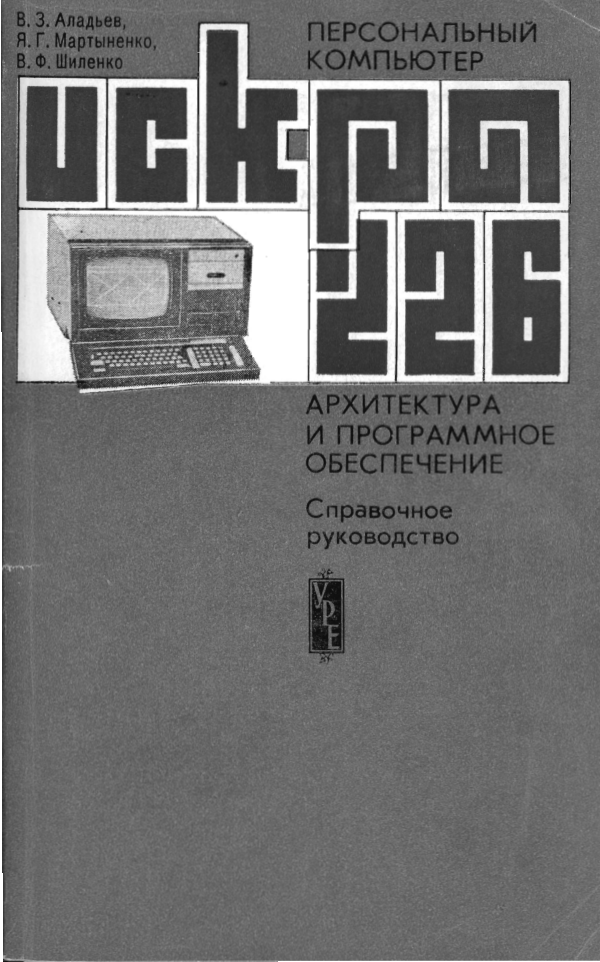
Персональный компьютер «Искра-226». Архитектура и программное обеспечение. Справочное руководство
Personal Computer Iskra-226. Architecture and Software. A Reference Guide
Программирование на микроЭВМ «Искра 226»
Programming the Iskra 226 Microcomputer
Основы языка Бэйсик ЭВМ Искра-226. Методические указания по дисциплине «Программирование на ЭВМ Искра-226». Часть 1
Fundamentals of the BASIC Language of the Iskra-226. Course notes, part 1
Основы языка Бэйсик ЭВМ Искра-226. Методические указания по дисциплине «Программирование на ЭВМ Искра-226». Часть 2
Fundamentals of the BASIC Language of the Iskra-226. Course notes, part 2
Программоуправляемая электронная клавишная вычислительная машина «Искра-226». Блок интерфейсный функциональный «Искра 015-85». Паспорт 3.055.210 ПС
Factory documentation: the Iskra 015-85 functional interface block, passport 3.055.210, and further block descriptions
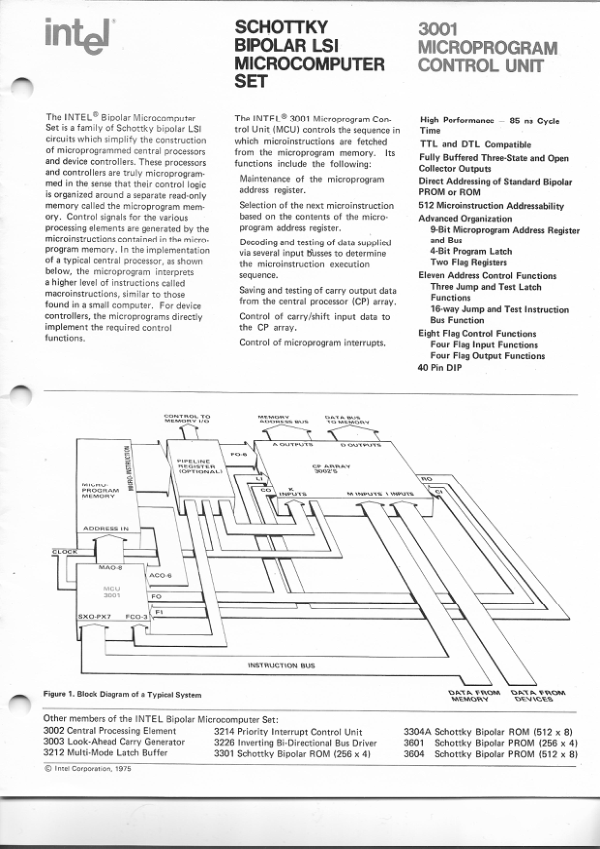
Intel 3001 Microprogram Control Unit, Schottky Bipolar LSI Microcomputer Set
What I checked
Every title, author line, year, place and page count in the list above I read off the document itself rather than off a catalog, and the two files that run to the same length were compared page by page: identical text, identical figures, identical rendering, different properties. The nine women and their works come from catalog records that are named one by one, so anyone can pull the same records and check me.
What this does not settle
The read only memory stays open at 8, 16 or 24 KB, and I would rather leave three numbers standing than pick the one that sounds best. Nine women is a lower bound out of one catalog and one query, not a total. The Zelenova line is a name in file properties and carries no attribution at all. The two disk banners name people that nothing outside the disks confirms. And the machine on this page is one I have never touched: what runs is an interpreter for its BASIC, on my own computer, and the processor is not executed anywhere.
Where to read more
- The Iskra-226 manuals Jim Battle's shelf, the largest collection of Russian documentation for this machine anywhere, and where most of what is in my docs folder came from. He asks for more, and he means it.
- The seven files, in the repository Four hundred and eighty one pages of Iskra material plus the Intel datasheet, mirrored so that they do not depend on one website staying up.
- The processor, as far as the books go Memory map, registers, instruction classes and the four documented encodings, with the boundary marked where the books stop and I would have to guess.
- The instruction set, read out of the books and the bytes The statistical check that decided it: 126,960 words of a boot image held against the encoding table, and the worked example from the book that comes out exact.