Ivan Pavlov
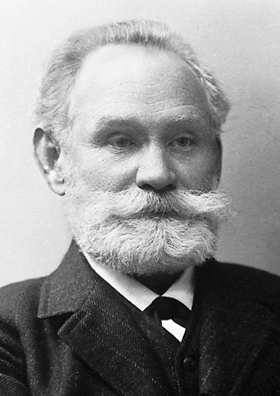
Conditioned reflex; first Russian Nobel laureate
Timeline - Pavlov in the record
6 events from the Ivanov's Ghost archive.
Ivan Pavlov is born in Ryazan, the son of a priest.
Prince Alexander of Oldenburg founds Russia's first modern biomedical research institute in St Petersburg, modelled on the Institut Pasteur. Pavlov will head its physiology department for 45 years.
Pavlov takes charge of the Department of Physiology at the new Institute of Experimental Medicine in 1890 and heads it for the rest of his life, some forty-five years.
Pavlov begins the studies of conditioned reflexes, the body trained to respond to a signal, that will define the physiology of the mind.
Pavlov receives the Nobel Prize for his work on the physiology of digestion, the first Russian laureate.
Pavlov dies in Leningrad, aged 86, having straddled Imperial and Soviet Russia and lavished with resources despite denouncing the regime.
The research file for this dossier holds 6 verified source entries, 6 of them distinct works. The sources page lists every one of them with what it covers, how it was reached, and the sharpest point at which this page and its sources come apart.