Ural series
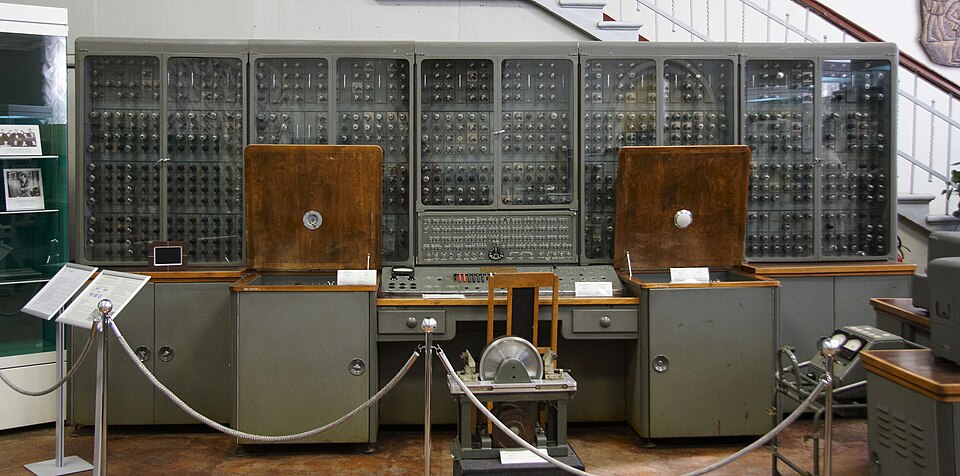
Most widespread Soviet computers of the early 1960s (183 Ural-1 built)
Ural series in the timeline
The passionate mountaineer, aged about 35, is said to have climbed the 5,642-meter Elbrus; a colleague recalled crawling the last 50 meters while Lebedev 'boldly leapt over the rocks'. His later supercomputer series will be named Elbrus.
Bashir Rameev's father, a German-trained mining engineer, is arrested and dies in a camp around 1943. Rameev is expelled from the Moscow Energy Institute as 'son of an enemy of the people'; he will later co-author the first Soviet computer patent and create the Ural series.
Minister P. I. Parshin takes personal responsibility for the son of an 'enemy of the people' and brings Rameev to the new SKB-245 for work of 'special state importance'. His design becomes the basis of the Strela, the first Soviet series-produced computer; as deputy chief designer he pushes through vacuum tubes over slow relays.
The Strela ('Arrow'), completed at the end of 1953 at SKB-245 under chief designer Yuri Bazilevsky, with Bashir Rameev as his deputy, becomes the first Soviet electronic computer built in series: about 6,000 tubes, roughly 2,000 operations per second, some 7 units built.
The M-3 (only 770 tubes, 3,000 cuprox diodes, about 3 square meters) is built outside the state plan and 'born out of wedlock': the state commission at first refuses to accept it. It becomes the prototype for the Minsk series in Belarus and the Razdan/Nairi machines in Armenia, and is transferred to China and Hungary.
The Ural-1 (100 operations per second, 183 units built) becomes the most widespread computer in the country by the early 1960s, running in 128 cities and exported to 25 countries. On average every second or third mid-range computer in the USSR is a Ural.
Bashir Rameev creates the Ural computer family in Penza, workhorses of Soviet computing. In 1962, at 44, he receives a doctorate without a dissertation on the recommendation of Lebedev, Berg and Bruk. A wall newspaper quoted him: 'It is easier for me to build another computer than to go on stage and give a talk!'
Seminar participant Poletayev publishes the first Soviet book on cybernetics (Gaase-Rapoport follows in 1961), both at Lyapunov's urging. He also founds the influential series 'Problems of Cybernetics'.
Some 46 to 50 Setun machines are built at the Kazan mathematics plant, becoming popular teaching machines at over 30 universities. State acceptance follows in April 1960.
The Dnepr goes into production in Kyiv the same year the US starts producing a comparable universal control machine; over ten years it automates shipyards, steel and chemical plants and test rigs at Korolev's design bureau.
The Soviet Union's greatest technological triumph, achieved with domestic computers like the BESM series still designed at home, before the era of cloning.
Kartsev's transistorized M-4 (23-bit, about 50,000 additions per second, with what its builders call the world's first hardware square root) passes joint state trials inside an experimental radar complex for surveillance of outer space. Its two sets work with the radars until 1966 and set the course of Kartsev's M series.
Viktor Przhiyalkovsky's team at the Minsk Ordzhonikidze plant completes the Minsk-2, the first transistorized computer to enter series production in the USSR, and one of the first Soviet machines to handle alphanumeric text. With the plant and design bureau under one roof, new models reach the production line within months, and the Minsk-2/22 line sells 852
Designed from 1957 for Academician Mints's experimental radar complex, the M-4 was one of the first Soviet transistor computers. It completed joint state trials with the radar in July 1962, and in November was ordered into series production.
Glushkov's Kyiv institute puts the Promin ('Ray') into series production at Severodonetsk: the first Soviet mini-computer, with metallized-card memory and the first widely used stepped microprogram control. The scheme is never patented abroad: the USSR does not belong to the international patent union.
The Nairi series, operable by a single person, anticipates the personal computer; its architecture is patented in England, Japan, France and Italy. The Nairi-3 (1970) becomes the first Soviet third-generation computer.
Judging the M-4 prototype unfit for series, Kartsev fought all winter against institute management, who called the redesign an adventure that would never be finished, until a government decision backed him. The first two M4-M machines (220,000 ops/s) reached duty in October 1964; over 100 sets were built until 1985, and the work earned him the 196
At the spring 1965 Leipzig international fair, Yerevan's one-user Nairi-1 is shown alongside small computers from Western firms and stands the comparison. Series production starts the same year in Armenia and at the Kazan computer plant, which alone builds over 500 machines by 1970; the family's microprogrammed architecture is patented in England, Japan, Fra