Setun
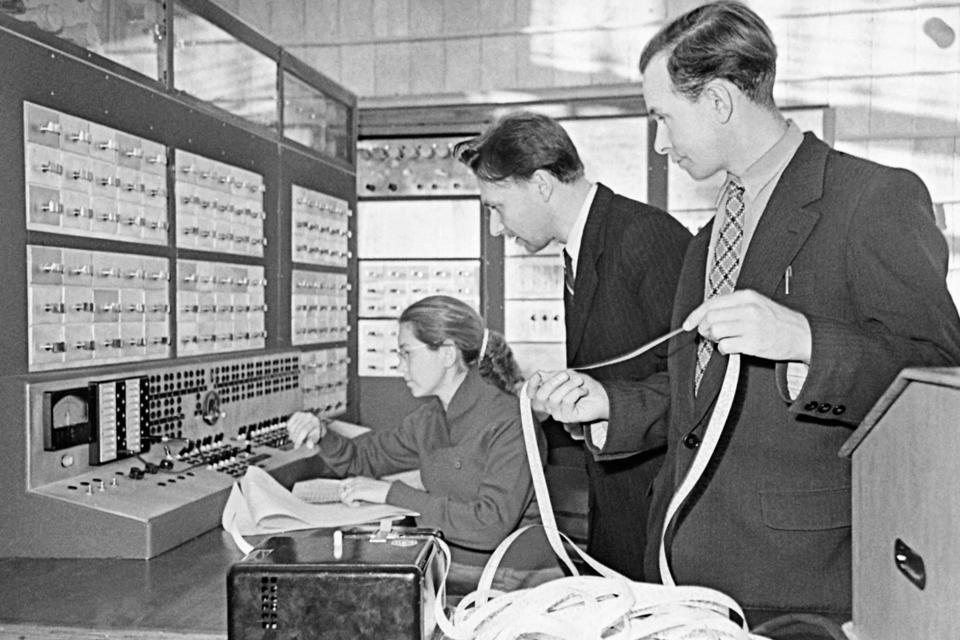
World's only series-produced ternary computer (46 to 50 built, depending on the source)
Setun in the timeline
Thomas Fowler builds a mechanical ternary calculating machine; apart from theoretical work by Shannon and Knuth (who called balanced ternary 'graceful'), the West never produces a ternary production computer. Setun remains unique.
Operation Barbarossa begins. The day before, eighth-grader Nikolai Brusentsov, future creator of the ternary Setun, conducted a choir performing his own composition at a music competition.
After the offended Bruk refuses to hand over an M-2 (Sobolev had voted for Lebedev, not Bruk, in the Academy elections), Sobolev declares: 'Let us build a computer for educational institutions ourselves.' At a seminar the task is formulated and Brusentsov named chief designer. Of Sobolev he said: 'When I first entered his office, it was as if sunlight floode
The prototype of the ternary computer, built by never more than two dozen people in a single 60-square-meter room at MGU, runs after only ten days of adjustment, an unheard-of record. Every workday began with a warm-up: each person, the boss included, hand-wound 52 turns of wire onto five 3-mm ferrite cores with an ordinary needle. The machine is named after
Seymour Cray builds one of the first fully transistorized commercial computers; the same year Brusentsov completes the ternary Setun in Moscow.
At Moscow State University, Nikolai Brusentsov's team of about 20 completes the world's only modern ternary computer, initiated by Sergei Sobolev and named after the little river Setun. Balanced ternary logic (trits of -1/0/+1), 18-trit words, a few hundred operations per second in the original description, up to 4,500 in later accounts, built from ferrite cores and germanium diodes, not tubes. The team assembled it a
The team is summoned before the State Committee for Radio Electronics and told the machine is not needed; Gosplan wants the project closed. Asked whether he had even seen the working machine, opponent Aleksandrov replies: 'We need neither see nor know it: there must be an authoritative paper with stamps and signatures.' Sobolev goes all the way to the Centra
Some 46 to 50 Setun machines are built at the Kazan mathematics plant, becoming popular teaching machines at over 30 universities. State acceptance follows in April 1960.
The interdepartmental commission certifies Setun as the first working universal computer built without vacuum tubes, showing 95 percent useful time when 60 percent counted as very good. Serial production is assigned to the Kazan Mathematical Machines Plant.
The director of the Kazan plant is forced to sign an act ending attempts to halt Setun production. The plant has no interest in the machine: it is too cheap to be profitable. Only 10-20 machines a year are built: the ministerial decree formally 'fulfilled', factually strangled, despite orders from home and abroad, including the USA and England.
Brusentsov receives the exhibition's Grand Gold Medal for the Setun; in 1982 he receives the Prize of the USSR Council of Ministers. A Czechoslovak factory prepares to license the machine, but the documentation is withheld and the deal dies.
Production is stopped after about 50 machines (46 serial units) deployed from Kaliningrad to Yakutsk, replaced by a binary machine of equal performance that costs 2.5 times more. The same year Brusentsov defends his candidate dissertation on the ternary computer's fast magnetic amplifier logic.
Production ends not for technical flaws but because the sales price was deemed 'too low'; the replacement is a binary machine of equal performance that costs 2.5 times more. Brusentsov complained bitterly that bureaucrats wanted to eliminate the 'ugly duckling' of university imagination.
The successor Setun-70 is approved as MGU's 'production gift' for Lenin's centenary. Brusentsov must write the test programs himself; the programmer Jose Ramil Alvarez, son of Spanish Civil War refugees, becomes his decisive helper and lifelong collaborator.
The Setun-70, with its unusual two-stack architecture ideal for structured programming ('true RISC can only be ternary'), remains a single specimen. The new computing center head deems MGU no place for computer building, the rector calls Brusentsov's research pseudoscience, and computer development is forbidden to him by administrative order. The lab is bani
Brusentsov's successor machine introduces the 'tryte' (6 trits) and a two-stack architecture realizing Dijkstra's structured programming in hardware. After it, ternary research ends; the West never built a production ternary computer at all.
The original Setun, which had run for 17 years without failure and was used until its last day, is barbarically destroyed: cut to pieces and dumped. Brusentsov: 'It was bitter that we were not understood, but then I saw this is the normal state of human society. William of Ockham, who preached three-valued logic, barely escaped the stake.'
The original Setun, which had run 17 years without failure, is shut down, 'barbarically destroyed, cut into small pieces and carted to a dump'. No one has convincingly explained why a working, unique computer was destroyed.
This object is named in 6 verified source entries across 2 dossiers of this book. The entries sit with the people who built or used it, which is where the research recorded them.