Nairi family
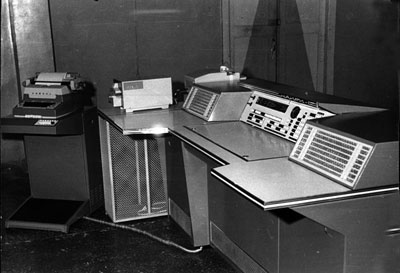
Yerevan engineering minicomputers with formula input
Nairi family in the timeline
Isaak Bruk is born into a poor Jewish family in Minsk; his father is a clerk in a tobacco factory. Despite scarce means the parents insist on education: his sister Mirra will become an art historian, and workshop masters at the local 'Energiya' plant explain machines to the insatiably curious boy.
Alexei Lyapunov is born in Moscow (September 25 old style) into the ancient Ryazan noble family of the Lyapunovs, kin of the great mathematician Alexander Lyapunov, the composer Sergei Lyapunov. In the young Soviet state, noble descent is a social stain.
Kantorovich is born into a Russian-Jewish family in St. Petersburg. His father Vitali is a well-known physician; almost the whole family, except Leonid, will become doctors.
Bashir Rameev is born in the village of Baimak (his passport says May 15; his father misregistered the date by 15 days). His grandfather Zakir Rameev, who mined five tons of gold, was both a Duma deputy and, under the pen name Derdmend, a classic of Tatar poetry. After 1917 the family fortune is expropriated.
The Lebedev family settles in Moscow around this time. Sergei (chess player, Oka-crossing swimmer, pianist who plays Beethoven and Grieg) prepares intensively for the entrance exam of the Bauman Higher Technical School, which he enters in 1921.
Anatoly Kitov is born into a family carrying a dangerous secret: his father Ivan had served as a junior officer in the White Army during the civil war.
Fearing Bolshevik reprisals for the father's White Guard past and fleeing the Volga famine, the family moves to Tashkent, where the father hides his history and works as a bookkeeper. The mother raises five children.
When Leonid is ten, his father dies. From then on his mother Paulina raises the future prodigy alone, shortly after the family's return from wartime refuge in Belarus.
Viktor Glushkov is born into an old Don Cossack family; his father is a mining engineer. An ancestor served as adjutant to Ataman Platov at the Battle of Borodino in 1812.
Tamara Aleksandridi is born in Tomsk; the family moves to Moscow in 1929.
Elena Glivenko is born in Moscow; her father is the mathematician Valery Glivenko, her mother a professor of medicine.
The family relocates to the coal town of Shakhty. His illiterate grandmother learned to read at 53 to read to him, but by four and a half, Viktor could already read himself.
His father Iskander, a Freiberg-trained mining engineer, is arrested for the first time and held about a year without charge. The destitute family's oldest male is now eleven-year-old Bashir, who works as a photographer on a geological expedition, then as a bookbinder.
Lebedev marries Alisa Grigoryevna Steinberg, a cellist and Gnessin Institute graduate from a Jewish grain merchant family.
Elena Lyapunova is one of two daughters who will make the family famous in Soviet genetics.
Evacuated with his institute to the Urals, Lebedev develops a stabilization system for tank cannons allowing accurate aiming at full speed (credited with saving many tank crews), and later a self-homing warhead for an aerial torpedo. His family is evacuated.
On the eve of the invasion, sixteen-year-old Brusentsov conducts a choir at an amateur arts olympiad in Dnepropetrovsk, performing a song of his own composition. The next morning the war begins. 'So ended Nikolai's childhood.' The family is soon evacuated to the Orenburg steppe, living first in tents.
The family receives a document saying the father suffered a 'heart attack'. 'Later we learned he was shot. It was a kind of code: a certain diagnosis denoted the method of killing,' her daughter recalled. His traces vanish at Bykivnia, the mass grave site near Kiev. The parents are rehabilitated in 1954, after Stalin's death, 'for absence of a crime'.