MIR
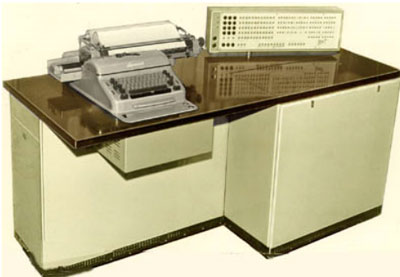
Kyiv engineering-calculation machines that hardware-interpreted a high-level language
MIR in the timeline
Isaak Bruk is born into a poor Jewish family in Minsk; his father is a clerk in a tobacco factory. Despite scarce means the parents insist on education: his sister Mirra will become an art historian, and workshop masters at the local 'Energiya' plant explain machines to the insatiably curious boy.
At the physics and mathematics faculty, professors Günther and Smirnov quickly recognize his talent; he graduates in 1929 and opens a new field of mathematical physics with Smirnov.
Vladimir Melnikov was born in Venyukovo, Moscow region, and went on to study automation and telemechanics at the Moscow Energy Institute.
Vladimir Lukyanov builds the world's first machine for solving partial differential equations using water: levels in chambers represent numbers, flow rates the operations. Built from roofing sheet and glass tubes to prevent cracks in concrete, later mass-produced from 1955 and used on the Karakum Canal and the Baikal-Amur Mainline.
Discharged under a decree recalling specialists for reconstruction, Rameev joins TsNII-108 under Admiral Axel Berg, founder of Soviet radar. Berg covers for his tainted background and teaches him the circuit elements (triggers, registers, counters, decoders) that will become the building blocks of his computers.
Isaak Bruk and Bashir Rameev co-author the first Soviet computer patent. Admiral Axel Berg had introduced the two that year; Rameev had reportedly learned of ENIAC from BBC broadcasts, an extremely dangerous thing to listen to.
Academician Axel Berg sends the young engineer Bashir Rameev to Bruk. Rameev, grandson of a Tatar poet and son of a repressed 'enemy of the people', had been expelled from university and has no formal degree: exactly the kind of talent with a 'flawed' biography that Bruk likes to hire.
British Admiralty clerk John Vassall is plied with drink at a Moscow party, photographed with men, and blackmailed for seven years. He delivers thousands of documents on radar, torpedoes and anti-submarine defense.
Colonel Kitov writes to Khrushchev proposing to move 'from manual and personal forms of management to automated systems based on computers', linking all computing centers into a nationwide network. A commission under Admiral Berg approves the general ideas, but not the core network vision.
Glushkov's Kiev institute builds the MIR-1, whose machine language is close to a high-level language (ANALITIK could transform algebraic expressions). The MIR machines count as early precursors of the personal computer.
At a London exhibition IBM purchases the displayed MIR-1, the only Soviet computer ever bought by an American company. The motive, Glushkov later learns, is prior art: proving to a competitor holding a 1963 patent that stepped microprogramming had run in Soviet series machines since the Promin.
The MIR-2 enters production in Kyiv, bringing the first dialog mode in Soviet computing practice: a display with a light pen. On symbolic mathematics it competes successfully with general-purpose machines whose nominal speed and memory exceed its own by hundreds of times.
Around 1980 Vladimir Kitov marries Olga Glushkova: the two pioneer families of the Soviet internet idea become in-laws. Glushkov's younger daughter Vera later jokes that OGAS was 'a family business': 'The first to propose it was my elder sister's father-in-law, Anatoly Kitov. For that he was dismissed and expelled from the party.'
In a single year, the Soviet Military-Industrial Commission issues 3,617 scientific-technical acquisition orders; 1,085 are completed and feed 3,396 Soviet R&D projects. It seems as if Soviet research is largely mirrored on the West's.
The ten-processor Elbrus-1 (15 million ops/s) pioneered superscalar execution and tagged memory; its base language El-76 was written by a team including the future Pentium architect Vladimir Pentkovski.
With Dashevsky, Shkabara publishes the first account of the MESM's construction, asserting Lebedev's priority. The book contains bitter passages about the decades of secrecy that blocked the team's recognition, yet its tone toward Lebedev is admiring: 'Sergei Alexeyevich rarely smiled, and whoever had not seen his smile did not suspect how much gentleness an
KGB colonel Vladimir Vetrov, disillusioned evaluator of Line X's stolen Western technology, passes nearly 4,000 secret documents to French intelligence, including the complete list of 250 Line X officers stationed worldwide under diplomatic cover.
KGB colonel Vladimir Vetrov ('Farewell') passes nearly 4,000 secret documents to French intelligence, exposing Line X, which covered two-thirds to three-quarters of Soviet technology needs in radar, computers and semiconductors. The CIA responds by feeding in deliberately flawed technology; Vetrov is executed in 1985.