M-4
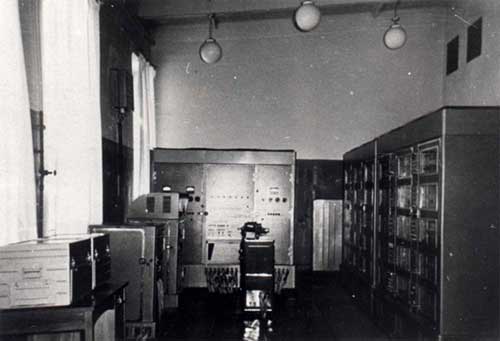
Transistor real-time computer for an experimental space-surveillance radar
M-4 in the timeline
Under Lebedev's direction, Burtsev builds the M-40 (and later M-50) computers for General Designer Kisunko's anti-ballistic missile system, following the special computers Diana-1 and Diana-2 of 1952-1955.
When INEUM begins the transistor M-4 for an experimental radar system of the Radio Engineering Institute under A. L. Mints, Glivenko is named head of its programming group.
His M-40 (40,000 ops/s) and floating-point M-50 machines of the experimental missile-defense System A were linked by 1959 into a computer network spanning hundreds of kilometers, with multiplexed channels moving a megabit per second, a decade before ARPANET.
The first M-4 is installed near Lake Balkhash; Glivenko's programmers travel out with Kartsev's engineers to write the radar data-processing programs on site.
Kartsev's transistorized M-4 (23-bit, about 50,000 additions per second, with what its builders call the world's first hardware square root) passes joint state trials inside an experimental radar complex for surveillance of outer space. Its two sets work with the radars until 1966 and set the course of Kartsev's M series.
The TsSO-P radar and the M-4 with her team's programs complete successful joint tests; computers move into Soviet early-warning service.
Designed from 1957 for Academician Mints's experimental radar complex, the M-4 was one of the first Soviet transistor computers. It completed joint state trials with the radar in July 1962, and in November was ordered into series production.
The world stands at the brink of nuclear war. Missile defense drives Soviet computing: Kartsev's M-4/M-10 machines and later the Elbrus serve early-warning and ABM systems.
Lebedev and Burtsev received the Lenin Prize for the missile-defense computing complexes built around the M-40 and M-50; his obituary dates the award to 1964.
Judging the M-4 prototype unfit for series, Kartsev fought all winter against institute management, who called the redesign an adventure that would never be finished, until a government decision backed him. The first two M4-M machines (220,000 ops/s) reached duty in October 1964; over 100 sets were built until 1985, and the work earned him the 196
Mikhail Kartsev, builder of the M-4/M-10/M-13 early-warning computers, dies; forcing his machines into serial production had wrecked his health, and the second time he did not survive it. His institute is named after him only ten years later.
In the USSR's final year, a complex of six M-13 machines passes state trials and goes on continuous round-the-clock real-time duty. Production ends in 1992 after eighteen sets, the close of the real-time computer line Kartsev began with the M-4 in 1957.
This object is named in 10 verified source entries across 3 dossiers of this book. The entries sit with the people who built or used it, which is where the research recorded them.