Elbrus
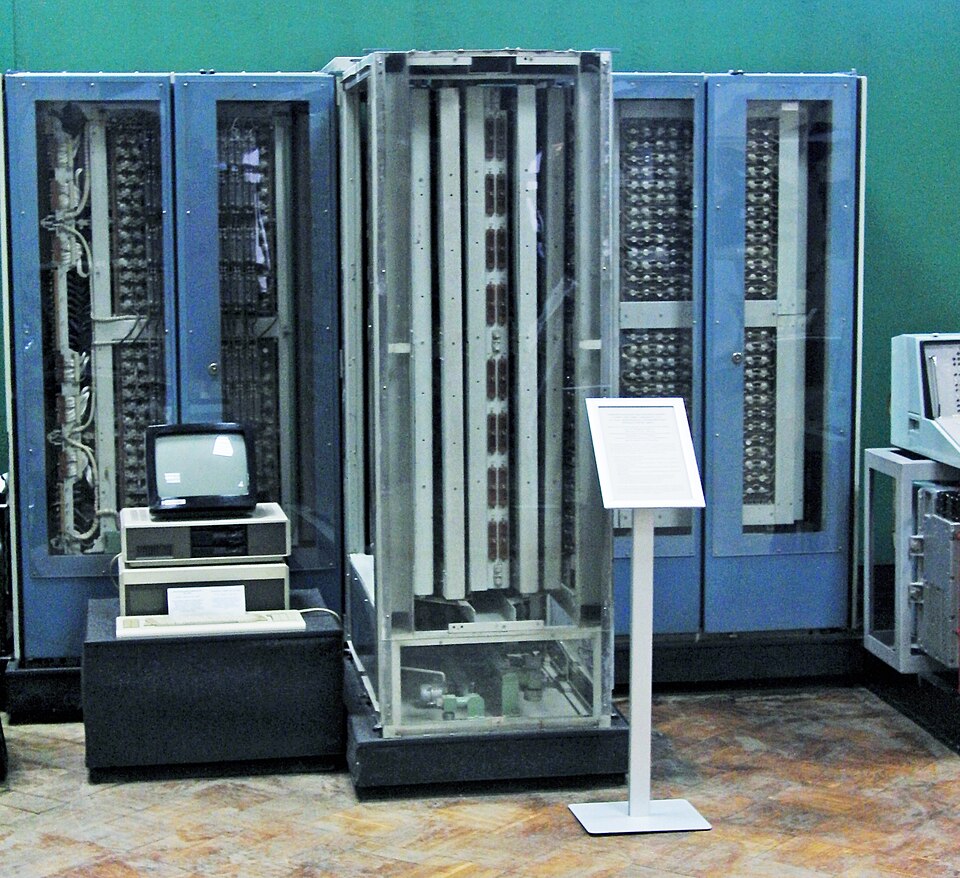
Soviet supercomputer line, named after the mountain Lebedev once climbed
Elbrus in the timeline
The passionate mountaineer, aged about 35, is said to have climbed the 5,642-meter Elbrus; a colleague recalled crawling the last 50 meters while Lebedev 'boldly leapt over the rocks'. His later supercomputer series will be named Elbrus.
The world stands at the brink of nuclear war. Missile defense drives Soviet computing: Kartsev's M-4/M-10 machines and later the Elbrus serve early-warning and ABM systems.
Severe illness, worsened, according to his biographer Malinovsky, by the lost fight against copying IBM, forces Lebedev to resign as ITMiVT director. He keeps working from home on the fundamentals of the Elbrus supercomputer. His pupil Burtsev succeeds him.
After Lebedev steps back, the institute is said to have chosen Vsevolod Burtsev's Elbrus concept over a BESM-10 proposal. Lebedev himself had argued heatedly against a multiprocessor Elbrus; Glushkov backed both. The supercomputer line is named after the mountain Lebedev climbed at 35.
The vector multiprocessor built from the M-9's 'number bundle' entered series production and became the heart of the Soviet missile-attack early-warning system. At 5.1 million operations per second it remained the most powerful Soviet computer until the Elbrus.
When illness forced his teacher out, Burtsev took over the institute and directed it through the Elbrus years; the sources end his directorship in 1984 or 1985.
The Elbrus-1 prototype under Vsevolod Burtsev (completed 1975, state trials passed 1978, about 15 million operations per second, up to 10 CPUs) uses superscalar out-of-order execution. Babayan later claims this anticipated Western implementations by over a decade, a disputed priority claim, since the CDC 6600 came eleven years earlier.
The ten-processor Elbrus-1 (15 million ops/s) pioneered superscalar execution and tagged memory; its base language El-76 was written by a team including the future Pentium architect Vladimir Pentkovski.
Up to about 800-941 megaflops. Between 1976 and 1984 Cray Research ships on average seven supercomputers a year; the CIA estimates the USSR builds five to ten Elbrus machines annually, at drastically lower performance and reliability.
The Elbrus-2 (10 processors, faster ECL chips, over 100 million operations per second) serves in the nuclear centers Chelyabinsk-70 and Arzamas-16 and later in the A-135 missile defense system. Babayan receives the Lenin Prize for it.
The West is now orders of magnitude ahead of the Elbrus-2. Cray's amused observation, on learning Apple bought a Cray to simulate the next Apple: 'Funny, I am using an Apple to simulate the Cray-3.'
The ten-processor Elbrus-2 reached 125 million operations per second on new ECL chips, connectors and multilayer boards Burtsev pushed through industry; about thirty served missile defense, mission control and the nuclear centers. That same year, 'owing to circumstances,' he had to leave ITMiVT, and his vector processor wa
Under Boris Babayan the 16-processor Elbrus-3 pioneers VLIW architecture, which Babayan calls 'post-superscalar', resembling the later Intel Itanium and Transmeta designs.
Alexander Kim, veteran of Babayan's Elbrus lab at the Lebedev Institute, founds MCST ('Moscow Center of SPARC Technologies'). The cooperation with Sun Microsystems brings investment and carries the highly qualified team through the 1990s.
Boris Babayan and Alexander Kim found the Moscow Center of SPARC Technology, keeping the Elbrus architecture line alive into the post-Soviet era.
Vladimir Pentkovski, lead architect of the Elbrus El-90 32-bit microprocessor (completed 1987) and the El-76 language, joins Intel after the collapse killed his El-91S project. He goes on to lead the Pentium III architecture and contribute to SSE, though the legend that 'Pentium' was named after him is refuted by Intel.
Vladimir Pentkovski, former Elbrus supercomputer architect, leads the Pentium III architecture and contributes to SSE, documented in Intel's own Technology Journal. The Soviet brain drain now designs America's flagship processor.
A new era of state consolidation begins, later including renewed ambitions for 'sovereign' domestic processors like Elbrus and Baikal.
This object is named in 4 verified source entries across 3 dossiers of this book. The entries sit with the people who built or used it, which is where the research recorded them.