Sergei Sobolev
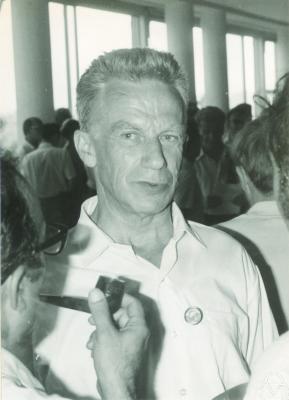
Youngest USSR academician; atomic-project mathematician; Setun's patron
Timeline - Sobolev in the record
12 referenced events from the Ternary Dreams archive.
Sergei Sobolev is born (September 23 old style) as the son of a lawyer. The father dies early; his mother Natalya, a highly educated teacher and physician, raises him.
Alongside school, Sobolev is said to have studied piano, the root of a lifelong love of classical music that colleagues would remark on decades later.
Sobolev's rise is meteoric: corresponding member of the USSR Academy of Sciences at just 24.
Elected full member of the Academy at 30, Sobolev remains the youngest academician of the country for years afterward. His name lives on in the Sobolev spaces, a cornerstone of modern analysis.
Sobolev sits as a deputy of the RSFSR Supreme Soviet from 1938 to 1948, a position that anchors him in the establishment and later helps make his name a political shield for others.
Sobolev directs the Steklov Mathematical Institute from 1942 to 1944 and organizes applied research for the front from its evacuation quarters in Kazan. He had won his first Stalin Prize in 1941.
Sobolev joins Laboratory No. 2 (the future Kurchatov Institute); from this moment his name disappears from the media. He becomes one of Kurchatov's deputies, working in Kikoin's group on uranium enrichment by gaseous diffusion. In these hidden years he also completes his masterwork on the function spaces now called Sobolev spaces.
Sobolev is said to have led a classified seminar of Laboratory No. 2 with participants including Landau, Fock and Tamm.
For his atomic work Sobolev is made Hero of Socialist Labor; in total he holds three Stalin Prizes (1941, 1951, 1953), to which a State Prize is added in 1986, and seven Orders of Lenin, the accumulated authority he will later spend on protecting condemned sciences.
After many revisions by Lyapunov and Sobolev, Sobolev offers his name as co-author of the draft defending cybernetics. 'The Main Features of Cybernetics' appears in Voprosy Filosofii with the atomic hero's signature as its political shield; he defends cybernetics repeatedly and publicly thereafter.
Like Lyapunov, Sobolev is named among the signatories of the letter denouncing Lysenko's monopoly over Soviet biology, using his decorated status for a persecuted science once again.
Sobolev takes part in founding the Siberian Branch and becomes director of its Institute of Mathematics, leaving Moscow at the peak of his fame. His own explanation: 'The natural desire of a person to live several lives, to begin something new.'
The research file for this dossier holds 6 verified source entries, 6 of them distinct works. The sources page lists every one of them with what it covers, how it was reached, and the sharpest point at which this page and its sources come apart.