Ekaterina Shkabara
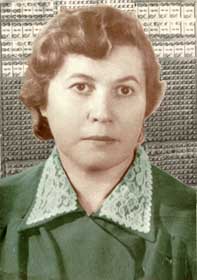
MESM control-unit engineer and party organizer of Lebedev's lab
Timeline - Shkabara in the record
13 referenced events from the Ternary Dreams archive.
Ekaterina Shkabara is born in Khotyn (today Chernivtsi oblast). Her father Alexei Shkabara is an agronomist.
During the war Shkabara heads the physical-technical laboratory at shell factory No. 63 in Nizhny Tagil, testing grenade casings with new magnetic methods.
Shkabara leads the development and debugging of the MESM's control unit and the control system of its magnetic drum memory, while serving as party organizer of the lab, organizing a collective that 'worked titanically without regard to the clock' in the half-ruined monastery, alongside engineers Gladysh, Abalyshnikova, Zorina-Rapota and Okulova.
When Lebedev moves to Moscow and wants to take his Kiev group along, the Ukrainian Central Committee is told that he is poaching scientists from Kiev. Lebedev is summoned: 'You want to leave? Please. But take no one with you.' The Kiev school stays, and later blossoms into Glushkov's cybernetics school.
The monograph 'The Small Electronic Calculating Machine (MESM)', written by Lebedev as early as 1949, appears. The team had been nominated for the Stalin Prize but came away empty-handed, the submission rejected 'without explanation' under decades of secrecy.
Shkabara comes close to being expelled from the Communist Party when someone remembers she is the 'daughter of an enemy of the people', the same stigma that had already cost her a position once, and that she shares with her Kiev contemporary Kateryna Yushchenko.
After the MESM, Shkabara joins the development of the 'Kiev' computer.
Alexei Shkabara, the agronomist whose arrest in the early 1930s had shadowed his daughter's whole career, dies.
Shkabara passes the books of Ashby and Wiener to the heart surgeon Nikolai Amosov. She then works with him on a model of a cybernetic machine for diagnosing heart disease, exhibited at the VDNKh.
As senior scientist at the Institute of Physiology of the Academy of Sciences, Shkabara leads the Laboratory of Physiological Cybernetics, turning from computing machines to the machinery of the body.
With Dashevsky, Shkabara publishes the first account of the MESM's construction, asserting Lebedev's priority. The book contains bitter passages about the decades of secrecy that blocked the team's recognition, yet its tone toward Lebedev is admiring: 'Sergei Alexeyevich rarely smiled, and whoever had not seen his smile did not suspect how much gentleness an
Exactly forty years after the MESM's state acceptance, Shkabara and Dashevsky receive the S. A. Lebedev Prize of the Ukrainian Academy. Her words: 'The time of intense work, lit by the happiness of creative labor with S. A. Lebedev, I shall never forget!'
Ekaterina Shkabara dies in Kiev, ten days short of her 90th birthday, one of the last of the Feofania monastery team.
The research file for this dossier holds 6 verified source entries, 6 of them distinct works. The sources page lists every one of them with what it covers, how it was reached, and the sharpest point at which this page and its sources come apart.