Bashir Rameev
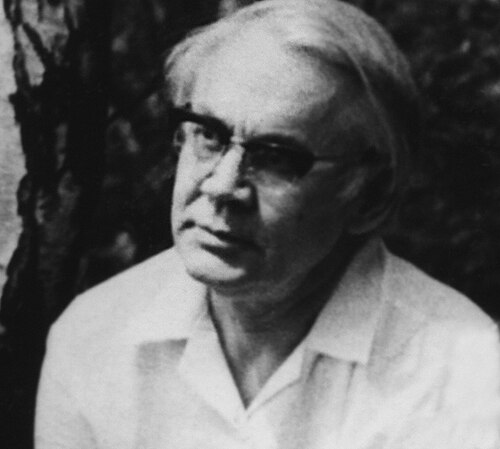
Chief designer of the Ural family; co-holder of the first Soviet computer patent
Timeline - Rameev in the record
14 referenced events from the Ternary Dreams archive.
Bashir Rameev is born in the village of Baimak (his passport says May 15; his father misregistered the date by 15 days). His grandfather Zakir Rameev, who mined five tons of gold, was both a Duma deputy and, under the pen name Derdmend, a classic of Tatar poetry. After 1917 the family fortune is expropriated.
At 17, Rameev is reportedly admitted to the All-Union Society of Inventors as its youngest member. His remote-controlled model of an armored train (which ran on rails, 'fired its cannon' and laid a smokescreen) draws public attention.
Having completed the tenth grade externally, Rameev starts at the Moscow Energy Institute (MEI); another source dates his entry to 1938.
The purges reach their peak. Repression strikes the future computing elite directly: Yushchenko's parents are arrested in 1937, Bashir Rameev's father in 1938: 'children of enemies of the people' will later build the Soviet Union's first computers.
Bashir Rameev's father, a German-trained mining engineer, is arrested and dies in a camp around 1943. Rameev is expelled from the Moscow Energy Institute as 'son of an enemy of the people'; he will later co-author the first Soviet computer patent and create the Ural series.
At the outbreak of war, Rameev volunteers for special signals battalion No. 771 serving the General Staff and Supreme Command, studying encryption technology and methods.
Iskander Rameev dies in a camp. He is rehabilitated later, 'for lack of a crime'. In every questionnaire, Bashir writes only that his father 'died', never where.
In a special UHF communications group of the 1st Ukrainian Front, Rameev takes part in the crossing of the Dnieper and the liberation of Kyiv.
Discharged under a decree recalling specialists for reconstruction, Rameev joins TsNII-108 under Admiral Axel Berg, founder of Soviet radar. Berg covers for his tainted background and teaches him the circuit elements (triggers, registers, counters, decoders) that will become the building blocks of his computers.
Late at night, the BBC's 'Science Survey' program carries Cambridge professor Douglas Hartree speaking about automatic calculating machines. Rameev, listening in Moscow, is electrified and reports the American invention to Berg, who immediately recommends him to computer pioneer Isaak Bruk.
Rameev becomes engineer-designer in Bruk's laboratory for electrical systems at the Energy Institute of the Academy of Sciences. Within three months, by August, the two present the project 'Automatic Digital Electronic Machine', remarkably using semiconductor diodes instead of failure-prone vacuum tubes in its logic.
Just three months into their collaboration, Bruk and Rameev submit a 16-page design for an automatic digital computer, signed 'Corresponding Member I. S. Bruk' and 'Engineer B. I. Rameev'. Within a year they file over 50 patent applications for computer components.
Bruk and Rameev receive inventor's certificate No. 10475, the first officially registered invention in the field of electronic digital computers in the USSR. December 4, 1948 is considered the birthday of Russian informatics.
Rameev is abruptly re-conscripted and sent to the Far East to train submariners, leaving Bruk without the one man who could work 'with his hands' on the electronics. It takes about half a year to get him back.
The research file for this dossier holds 7 verified source entries, 7 of them distinct works. The sources page lists every one of them with what it covers, how it was reached, and the sharpest point at which this page and its sources come apart.