Sergei Lebedev
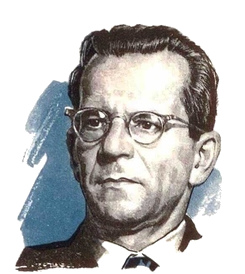
Chief designer of MESM and BESM; founder of the Soviet mainframe school
Timeline - Lebedev in the record
18 referenced events from the Ternary Dreams archive.
Sergei Lebedev is born as the third child of teacher and publisher Alexei Lebedev and the noblewoman-turned-teacher Anastasia Mavrina. The house is 'crammed with books'; his older sister Tatyana Mavrina will become a famous painter.
The Lebedev family moves for good to Moscow. Sergei (chess player, Oka-crossing swimmer, pianist who plays Beethoven and Grieg) prepares intensively for the entrance exam of the Bauman Higher Technical School.
Bruk graduates with a diploma thesis on new control methods for asynchronous motors, then works at the All-Union Electrotechnical Institute (VEI) until 1930, the same institute where his lifelong parallel figure Sergei Lebedev works.
Vsevolod Burtsev's path to computing ran through the Moscow Energy Institute, the school that supplied Lebedev's first computer team.
Lebedev finishes the Moscow Higher Technical School under the electrification pioneer Karl Krug. His diploma thesis deals with the stability of parallel power stations within the GOELRO electrification plan. He then joins the All-Union Electrotechnical Institute (VEI).
Lebedev marries Alisa Grigoryevna Steinberg (1911-1979), a cellist and Gnessin Institute graduate from a Jewish grain merchant family. In the 1930s the young couple lives in the apartment of Alisa's brother-in-law Mark Blumenfeld.
After his 1933 monograph on the stability of parallel electrical systems, Lebedev becomes a professor and soon heads the automation department at VEI. Colleagues note he is sincerely glad when others win awards: 'He never cared for honors or fame of any kind.'
The passionate mountaineer, aged about 35, climbs the 5,642-meter Elbrus with his colleague Svecharnik, who recalls crawling the last 50 meters while Lebedev 'boldly leapt over the rocks'. His later supercomputer series will be named Elbrus.
When the talented engineer Iosifyan is fired because his father had been an Armenian priest, Lebedev immediately invites him into his own department. Throughout the terror years he repeatedly finds positions for politically endangered colleagues.
Mark Blumenfeld, economist and Trotskyist husband of Alisa's sister, in whose apartment the Lebedevs had lived, is executed. Alisa's father, grain trader Grigori Steinberg, and her sister Yelena are also repressed. Alisa hates Stalin for the rest of her life.
Lebedev is awarded the degree of Doctor of Technical Sciences (bypassing the usual candidate degree) for his theory of artificial stability of power supply systems.
Twins Yekaterina (later a pianist) and Natalia are born. Natalia Lebedeva (1939-2025) will become the leading historian of the Katyn massacre: the daughter of a Soviet hero academician documenting Stalin's crimes.
During German air raids on Moscow, Lebedev locks himself in a windowless bathroom with a candle and a notebook, writing 'ones and zeros' for hours: his first work on binary arithmetic, as his wife Alisa later recalled.
Evacuated with his institute to the Urals, Lebedev develops a stabilization system for tank cannons allowing accurate aiming at full speed (credited with saving many tank crews), and later a self-homing warhead for an aerial torpedo. His family is evacuated.
A chance railway-platform encounter draws John von Neumann into the ENIAC project, the counterpoint to Lebedev rebuilding a ruined monastery: one architecture is sketched on the way to a train, the other heated with hand-chopped wood.
Lebedev constructs the USSR's first electronic analog computer for solving systems of ordinary differential equations, his bridge from power engineering to computing.
Lebedev is elected a full member of the Academy of Sciences of the Ukrainian SSR.
Called to head the Institute of Energetics in war-ruined Kiev, Lebedev faces his wife's refusal to move. The couple settles the argument with a coin toss. Friends later joked: 'The coin fell on the lucky side, for the Ukrainian Academy.' He also joins the Communist Party this year.