Anatoly Kitov
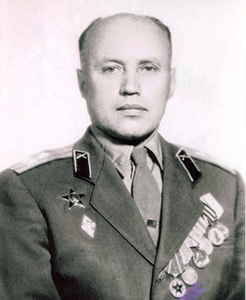
Military computing pioneer; proposed a national computer network in 1959
Timeline - Kitov in the record
12 referenced events from the Ternary Dreams archive.
Anatoly Kitov is born into a family carrying a dangerous secret: his father Ivan had served as a junior officer in the White Army during the civil war.
With the German invasion, Kitov is commissioned early as a junior lieutenant and sent to the Southern Front. He spends all four war years in anti-aircraft artillery, famously studying higher mathematics and physics in the pauses between battles.
Kitov is badly wounded in the battle for Stalingrad.
Kitov finishes the war in Germany. He never showed off his war record and hated wasting time on 'useless reminiscences'.
Germany capitulates. Veterans like Brusentsov, Kitov and Kartsev return from the front and move into engineering and mathematics.
Kitov enters the Dzerzhinsky Artillery Engineering Academy in Moscow and graduates in 1950 with a gold medal. He attends Kolmogorov's seminar at Moscow University on the side and becomes the most active pupil of mathematician Alexei Lyapunov's private home seminar.
In the classified library of SKB-245, Kitov finds Norbert Wiener's 'Cybernetics' (officially condemned as bourgeois pseudoscience) and concludes it is 'a serious and important science'. Still inside the secret library, he drafts the text that will rehabilitate cybernetics in the USSR.
Kitov defends 'Programming for ballistic problems of the long-range rockets', the first Soviet dissertation about programming.
At 33, Kitov founds and heads the Defense Ministry's Computing Center No. 1 (military unit 01168), the Soviet army's first computer center. It grows within two years into the country's most important scientific computing center, later calculating orbits for Soviet satellites and Gagarin's flight.
Kitov's article, co-signed by Lyapunov and academician Sobolev to lend it authority, appears in Voprosy Filosofii as the first positive Soviet article on cybernetics, ending its official status as 'reactionary pseudoscience'. Lyapunov calls Kitov 'the first knight of Soviet cybernetics'.
'Electronic Digital Machines' is the first Soviet book about computers, the book from which Viktor Glushkov, by his own repeated account, learned how computers work. Kitov's 1959 textbook with Krinitsky becomes the standard from which generations in the USSR, Eastern Europe and China learn.
Kitov patents the 'method of quadruple combination of computer command rate', an early pipeline/parallel-processing idea implemented in the M-100.
The research file for this dossier holds 6 verified source entries, 6 of them distinct works. The sources page lists every one of them with what it covers, how it was reached, and the sharpest point at which this page and its sources come apart.