Mikhail Kartsev
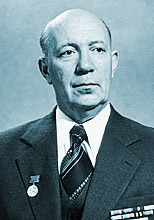
M-2 lead designer; chief designer of the M-4/M-10/M-13 missile-warning computers
Timeline - Kartsev in the record
9 referenced events from the Ternary Dreams archive.
Mikhail Kartsev finished school in June 1941, weeks before the German invasion, and that summer was sent to dig defensive works in the Donbass.
Germany capitulates. Veterans like Brusentsov, Kitov and Kartsev return from the front and move into engineering and mathematics.
As a moonlighting fifth-year student he joined Isaak Bruk's Electrosystems laboratory, one of about ten youngsters building the M-1. Kartsev designed the machine's control unit, the 'main program sensor,' also his diploma topic; the M-1 passed tests in December 1951.
Between April and December, Kartsev's team builds the M-2, credited in the literature with about 2,000 operations per second and built with a fraction of the tubes of comparable machines. It computes for Kurchatov's atomic institute.
Kartsev's transistorized M-4 (23-bit, about 50,000 additions per second, with what its builders call the world's first hardware square root) passes joint state trials inside an experimental radar complex for surveillance of outer space. Its two sets work with the radars until 1966 and set the course of Kartsev's M series.
The world stands at the brink of nuclear war. Missile defense drives Soviet computing: Kartsev's M-4/M-10 machines and later the Elbrus serve early-warning and ABM systems.
Judging the M-4 prototype unfit for series, Kartsev fought all winter against institute management, who called the redesign an adventure that would never be finished, until a government decision backed him. The first two M4-M machines (220,000 ops/s) reached duty in October 1964; over 100 sets were built until 1985, and the work earned him the 196
While the BESM-6 delivered a million operations per second, Kartsev proposed a machine computing over functions rather than numbers. Component technology of the day could not carry the full project.
The first stage of the Soviet missile-attack early-warning system is completed: more than fifty of Kartsev's M4-2M and M4-3M computers, joined by data channels thousands of kilometers long, form a territorial real-time computing network.
The research file for this dossier holds 6 verified source entries, 6 of them distinct works. The sources page lists every one of them with what it covers, how it was reached, and the sharpest point at which this page and its sources come apart.