Viktor Glushkov
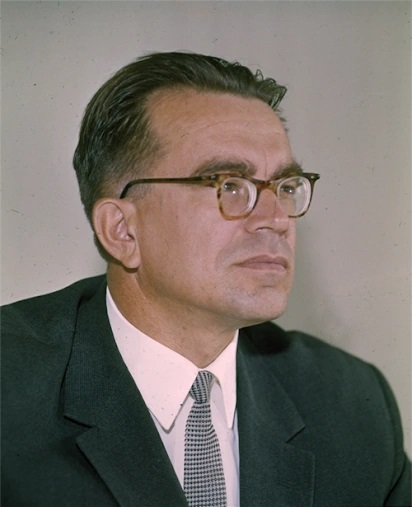
Founder-director of the Kyiv Institute of Cybernetics; father of OGAS
Timeline - Glushkov in the record
13 referenced events from the Ternary Dreams archive.
Viktor Glushkov is born into an old Don Cossack family; his father is a mining engineer. An ancestor served as adjutant to Ataman Platov at the Battle of Borodino in 1812.
Glushkov finishes school in Shakhty with a gold medal, dreaming of physics at Moscow University. The next morning he learns of the German invasion over his self-built radio receiver.
After liberation, Glushkov works at the coal face, then as quality and safety inspector, finally heading quality control for the Shakhtantratsit trust, before being freed for study on health grounds.
Glushkov's mother is shot during the German occupation of Shakhty; his biographers date it to the autumn of 1941. He later names his younger daughter Vera after her, and lays flowers at the memorial on every visit to Shakhty.
To switch to mathematics at Rostov University, Glushkov passes roughly 50 exams of the four-year course as an external student, cornering the astronomy professor in a bread-ration queue to take the exam on the spot. He finishes both the technical and the mathematical degree, his thesis exposing errors in integral tables that had survived 10-12 editions.
In his doctoral dissertation Glushkov solves the generalized fifth Hilbert problem; the solution reportedly came to him that summer while hiking the Georgian Military Road in the Caucasus. The sensation makes him an international mathematics star with job offers in Moscow, Leningrad and Kyiv. His wife says 'I want to go south', so it becomes Kyiv.
Glushkov inherits Lebedev's old computing laboratory at the Institute of Mathematics of the Ukrainian Academy of Sciences, housed in a half-ruined two-story building next to the monastery in Feofaniya. He himself said he learned how computers actually work from Anatoly Kitov's 1956 book.
The laboratory becomes the Computing Center of the Ukrainian Academy of Sciences with Glushkov as director. He personally recruits graduates; the average staff age is about 25; at 34, the director is nearly a decade older than his staff.
For New Year's parties, his staff create the virtual land of Cybertonia, ruled by a robot council, complete with passports, maps and a joke wedding automat issuing punch-card marriage certificates. Glushkov sits in the audience laughing heartily at parodies of his own institute.
As part of the OGAS vision, Glushkov proposes cashless electronic payments and paperless administration, decades ahead of its time.
The Computing Center becomes the Institute of Cybernetics of the Ukrainian Academy of Sciences. Within ten years it produces 60 doctors and around 500 candidates of science; it today bears Glushkov's name.
Brought to Deputy Premier Kosygin by Academy president Keldysh, Glushkov is tasked with OGAS: a three-tier real-time network: one central computer center in Moscow, up to 200 mid-level centers, up to 20,000 smaller computing centers in agencies and large plants, linked by dedicated broadband channels. To prepare, he personally studies over a hundred organizations of the planned economy.
In Voprosy Filosofii, Glushkov argues the machine is no rival to the human brain but a tool that amplifies it 'as the hammer amplifies the hand and the microscope the eye'.
The research file for this dossier holds 8 verified source entries, 8 of them distinct works. The sources page lists every one of them with what it covers, how it was reached, and the sharpest point at which this page and its sources come apart.