Vsevolod Burtsev
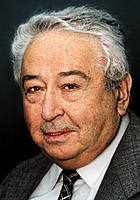
Lebedev's protégé; Elbrus chief designer and ITMiVT director
Timeline - Burtsev in the record
9 referenced events from the Ternary Dreams archive, plus 1 entry whose subject is another person.
Vsevolod Burtsev's path to computing ran through the Moscow Energy Institute, the school that supplied Lebedev's first computer team.
His diploma work on the control block, with the projects of fellow trainees including Vsevolod Burtsev, formed the BESM draft design.
Between 1953 and 1956 Burtsev achieved the first Soviet digital take-off of radar data; Diana-1 processed target tracks while Diana-2 guided the interceptor, following up to ten targets. He defended his candidate thesis on this work in the second half of the 1950s.
Under Lebedev's direction, Burtsev builds the M-40 (and later M-50) computers for General Designer Kisunko's anti-ballistic missile system, following the special computers Diana-1 and Diana-2 of 1952-1955.
The computer-controlled missile defense system destroys a ballistic missile for the first time. Lebedev, Kisunko and Burtsev later receive the Lenin Prize for it.
Lebedev and Burtsev received the Lenin Prize for the missile-defense computing complexes built around the M-40 and M-50; his obituary dates the award to 1964.
When illness forced his teacher out, Burtsev took over the institute and directed it through the Elbrus years; the sources end his directorship in 1984 or 1985.
The Elbrus-1 prototype under Vsevolod Burtsev (completed 1975, state trials passed 1978, about 15 million operations per second, up to 10 CPUs) uses superscalar out-of-order execution. Babayan later claims this anticipated Western implementations by over a decade, a disputed priority claim, since the CDC 6600 came eleven years earlier.
The ten-processor Elbrus-2 reached 125 million operations per second on new ECL chips, connectors and multilayer boards Burtsev pushed through industry; about thirty served missile defense, mission control and the nuclear centers. That same year, 'owing to circumstances,' he had to leave ITMiVT, and his vector processor wa
Burtsev died at 78. More than forty of his students had earned candidate and doctoral degrees, and he had taught at the Moscow Institute of Physics and Technology for nearly thirty years.
The research file for this dossier holds 6 verified source entries, 6 of them distinct works. The sources page lists every one of them with what it covers, how it was reached, and the sharpest point at which this page and its sources come apart.