Nikolai Brusentsov
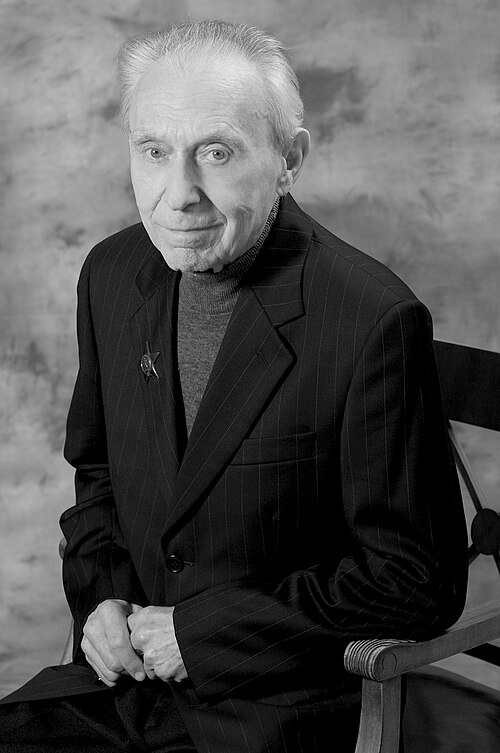
Creator of Setun, the world's only serial ternary computer
Timeline - Brusentsov in the record
18 referenced events from the Ternary Dreams archive.
Nikolai Brusentsov is born in Kamenskoye (later Dniprodzerzhynsk), eldest of three sons of a chemical engineer at the coke plant and a kindergarten director. Both grandfathers were railway workers. The boy shows no scientific ambition: he composes songs, plays balalaika and conducts the school choir.
His father Pyotr Brusentsov dies of peritonitis, reportedly at 37, leaving fourteen-year-old Nikolai the eldest of three brothers; the youngest is barely a year old.
On the eve of the invasion, sixteen-year-old Brusentsov conducts a choir at an amateur arts olympiad in Dnepropetrovsk, performing a song of his own composition. The next morning the war begins. 'So ended Nikolai's childhood.' The family is soon evacuated to the Orenburg steppe, living first in tents.
Operation Barbarossa begins. The day before, eighth-grader Nikolai Brusentsov, future creator of the ternary Setun, conducted a choir performing his own composition at a music competition.
While working as a carpenter's apprentice and attending night school, Brusentsov enters the folk instruments faculty of the Kiev Conservatory, evacuated to Sverdlovsk, but studies only briefly before the army calls.
The turning point of the war in the East. Brusentsov serves at the front from 1943; of 25 soldiers his age in his division, only five survive to victory.
Called up in Sverdlovsk, Brusentsov is spared the infantry for health reasons and trained as a radio telegraphist, which means carrying a radio station on his own back. He joins the fire-control platoon of an artillery regiment. From October 1943 he is at the front near Nevel; in one battle a mine lands at his feet and fails to explode.
For four days at the forward observation post under artillery and machine-gun fire, Brusentsov continuously relays firing commands to his battery by radio, earning the Medal for Courage. Of the twenty-five 18-year-olds who joined his division in August 1943, only five survive the war. His radio, the 13-R, was designed by V. B. Pestryakov, who will later beco
In the battle for Stolzenberg near Koenigsberg, Brusentsov restores lost communications under German tank and infantry counterattack, earning the Order of the Red Star. He ends the war in East Prussia and is demobilized in December 1945, remembering the front for 'the warmth of human relations: our joy, our happiness was our spiritual unity'.
Germany capitulates. Veterans like Brusentsov, Kitov and Kartsev return from the front and move into engineering and mathematics.
Reportedly, working as a draftsman at his father's old coke plant, Brusentsov designs a crane that does not fit: the real opening was smaller than the drawing he was given. 'The fitters cursed me, and I remembered that lesson forever: never trust any documentation blindly.' The family then moves to Kalinin, where he finishes night school with a gold medal.
Brusentsov travels to Moscow to enroll in the radio engineering faculty of the Moscow Energy Institute. Admissions are already closed, but the decorated front-line soldier is accepted anyway. In his first year he falls ill with tuberculosis and nearly has to leave, but recovers. Fellow student: future supercomputer designer Mikhail Kartsev.
Brusentsov graduates and is assigned to the special design bureau of Moscow State University. His final-year diffraction tables, published 1954 in the Vestnik MGU, are known as the 'Brusentsov tables' to this day. At MGU there is at first no interesting work, until his friend Kartsev shows him Bruk's M-2, which impresses him deeply.
After the offended Bruk refuses to hand over an M-2 (Sobolev had voted for Lebedev, not Bruk, in the Academy elections), Sobolev declares: 'Let us build a computer for educational institutions ourselves.' At a seminar the task is formulated and Brusentsov named chief designer. Of Sobolev he said: 'When I first entered his office, it was as if sunlight floode
In the summer of 1957, by his own later account, Brusentsov sketches out every detail of the future machine in a notebook. The key insight came from Gutenmacher's ferrite-diode cells: 'What if we let the compensation core work? Then every cell becomes three-valued.' Ternary logic needs seven times fewer cores at nearly double the word width.
Seymour Cray builds one of the first fully transistorized commercial computers; the same year Brusentsov completes the ternary Setun in Moscow.
At Moscow State University, Nikolai Brusentsov's team of about 20 completes the world's only modern ternary computer, initiated by Sergei Sobolev and named after the little river Setun. Balanced ternary logic (trits of -1/0/+1), 18-trit words, a few hundred operations per second in the original description, up to 4,500 in later accounts, built from ferrite cores and germanium diodes, not tubes. The team assembled it a
Brusentsov receives the exhibition's Grand Gold Medal for the Setun; in 1982 he receives the Prize of the USSR Council of Ministers. A Czechoslovak factory prepares to license the machine, but the documentation is withheld and the deal dies.
The research file for this dossier holds 8 verified source entries, 8 of them distinct works. The sources page lists every one of them with what it covers, how it was reached, and the sharpest point at which this page and its sources come apart.