Isaak Bruk
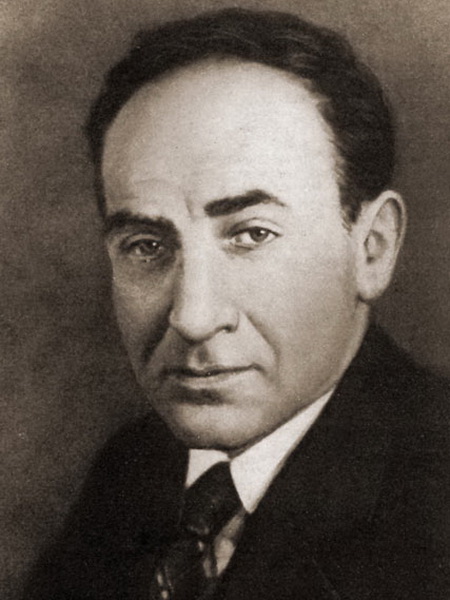
Father of Soviet small computers (M-1); founder of INEUM
Timeline - Bruk in the record
15 referenced events from the Ternary Dreams archive.
Isaak Bruk is born into a poor Jewish family in Minsk; his father is a clerk in a tobacco factory. Despite scarce means the parents insist on education: his sister Mirra will become an art historian, and workshop masters at the local 'Energiya' plant explain machines to the insatiably curious boy.
Bruk graduates with a diploma thesis on new control methods for asynchronous motors, then works at the All-Union Electrotechnical Institute (VEI) until 1930, the same institute where his lifelong parallel figure Sergei Lebedev works.
At the Kharkov Electromechanical Works, Bruk leads the construction of several novel machines, including explosion-proof asynchronous motors.
Back in Moscow at the Energetics Institute (ENIN), Bruk builds an AC network analyzer table for modeling large power grids, his first analog computing machine. In 1936 he defends his doctorate.
Bruk is elected a corresponding member of the USSR Academy of Sciences after reporting on his huge mechanical differential analyzer: about 60 square meters, over a thousand gears, solving differential equations up to sixth order. Only the USA and Britain had comparable machines. He remains a corresponding member for life, never elected full academician.
With ENIN evacuated to Kazan, Bruk works on anti-aircraft fire control systems and invents a synchronizer allowing an aircraft cannon to fire through the rotating propeller: mechanical analog devices with cone-shaped computing elements. For this he is elected a full member of the Academy of Artillery Sciences in 1947.
Academician Axel Berg sends the young engineer Bashir Rameev to Bruk. Rameev, grandson of a Tatar poet and son of a repressed 'enemy of the people', had been expelled from university and has no formal degree: exactly the kind of talent with a 'flawed' biography that Bruk likes to hire.
Just three months into their collaboration, Bruk and Rameev submit a 16-page design for an automatic digital computer, signed 'Corresponding Member I. S. Bruk' and 'Engineer B. I. Rameev'. Within a year they file over 50 patent applications for computer components.
Bruk and Rameev receive inventor's certificate No. 10475, the first patent registered in the USSR for an electronic digital computer.
Rameev is conscripted into the army as a radar specialist; when freed, he goes to SKB-245 (future home of the Strela) instead of returning. Bruk 'loses his only collaborator' and the joint project remains on paper. Yet in 1962 Berg and Lebedev will still recommend Rameev for a doctorate without defense.
The Academy presidium issues the directive to build the M-1. Bruk assembles a team of very young MEI graduates and students: Matyukhin, Kartsev (still a fifth-year student), Aleksandridi and others, none with an academic degree except Bruk himself. Legend has it he mistook 'Aleksandridi' for a man's name; he did not normally hire women.
In the cold winter, Bruk gives his own leather coat to his penniless young engineer Nikolai Matyukhin, who has nothing warm to wear. 'He treated us like a father,' Aleksandridi recalled; every morning he came literally running into the lab.
Isaak Bruk's team finishes the M-1 almost simultaneously with the MESM; the two teams knew nothing of each other due to secrecy. Bruk used captured German parts; Tamara Aleksandridi designed the CRT memory. Legend has it that Bruk, who distrusted women, hired her only because he mistook 'Aleksandridi' for a man's name.
Between April and December, Kartsev's team builds the M-2, credited in the literature with about 2,000 operations per second and built with a fraction of the tubes of comparable machines. It computes for Kurchatov's atomic institute.
The Strela ('Arrow'), completed at the end of 1953 at SKB-245 under chief designer Yuri Bazilevsky, with Bashir Rameev as his deputy, becomes the first Soviet electronic computer built in series: about 6,000 tubes, roughly 2,000 operations per second, some 7 units built.
The research file for this dossier holds 8 verified source entries, 8 of them distinct works. The sources page lists every one of them with what it covers, how it was reached, and the sharpest point at which this page and its sources come apart.