Tamara Aleksandridi
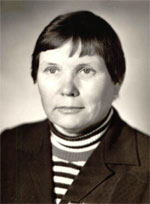
M-1/M-2 memory engineer; wartime front-line radio operator
Timeline - Aleksandridi in the record
7 referenced events from the Ternary Dreams archive.
Tamara Aleksandridi is born in Tomsk; the family moves to Moscow in 1929.
The Academy presidium issues the directive to build the M-1. Bruk assembles a team of very young MEI graduates and students: Matyukhin, Kartsev (still a fifth-year student), Aleksandridi and others, none with an academic degree except Bruk himself. Legend has it he mistook 'Aleksandridi' for a man's name; he did not normally hire women.
Isaak Bruk's team finishes the M-1 almost simultaneously with the MESM; the two teams knew nothing of each other due to secrecy. Bruk used captured German parts; Tamara Aleksandridi designed the CRT memory. Legend has it that Bruk, who distrusted women, hired her only because he mistook 'Aleksandridi' for a man's name.
Tamara Aleksandridi, war-veteran radio operator from the Crimea to Berlin, sole woman among the M-1 engineers and creator of its oscilloscope-tube memory, marries chief engineer Nikolai Matyukhin. 'We were together practically all the time, from eight in the morning until late at night,' she recalled.
When Aleksandridi and Matyukhin's daughter is born, Bruk personally helps them get a room. But when Aleksandridi asks to enter doctoral study he refuses: 'a scientist cannot be trained, one is born a scientist', and she leaves for another institute. His hostility to formal training costs him his school.
Two surviving members of Bruk's M-1 team, Tamara Aleksandridi and Yuri Rogachev, both well over 90, receive IEEE commemorative badges as builders of the first Soviet computer M-1. INEUM today bears Bruk's name.
One of the last participants of the M-1 project, war veteran and professor, dies in Moscow.
The research file for this dossier holds 7 verified source entries, 7 of them distinct works. The sources page lists every one of them with what it covers, how it was reached, and the sharpest point at which this page and its sources come apart.