Vostok
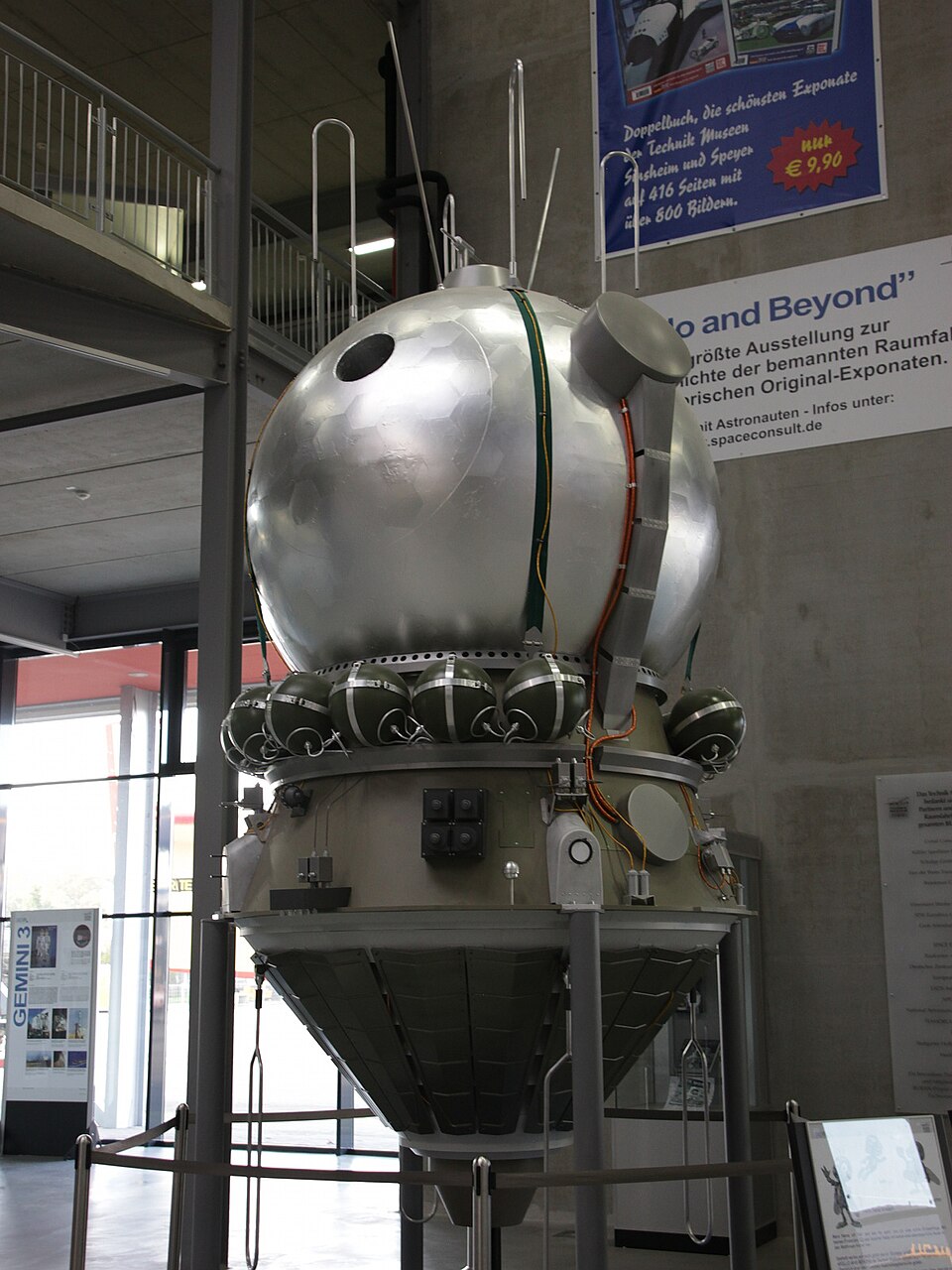
Gagarin's and Tereshkova's spacecraft
Vostok in the timeline
Appointed chief designer of long-range ballistic missiles, Korolev builds the bureau (OKB-1, later Energia) in Kaliningrad near Moscow that will produce Sputnik, Vostok and Soyuz.
From 1951 Chertok leads control-systems design for Sputnik, Vostok, Soyuz and the stations, at the technical heart of every mission.
The R-7 Semyorka, the world's first intercontinental ballistic missile, makes its maiden flight. Its descendants (Vostok, Voskhod, Soyuz) will fly for seventy years.
At Korolev's bureau, Feoktistov is a lead designer of the Vostok capsule that carries Gagarin, and then of Voskhod and Soyuz, the engineer who drew the ships. The year he moved onto the Vostok work is not established by the research behind this archive.
Chosen among twenty pilots, Gagarin's calm, small stature (an advantage in the cramped Vostok) and easy charm mark him out. Korolev takes to him personally.
Yuri Gagarin becomes the first human in space aboard Vostok 1. The USSR wins the opening round of the crewed race; Gagarin's smile becomes the face of Soviet modernity.
A final Vostok test flies the dog Chernushka and a mannequin, 'Ivan Ivanovich', with a tape recorder aboard, to prove the life-support and recovery systems weeks before Gagarin.
Gherman Titov spends more than 25 hours aboard Vostok 2, and becomes the first human to suffer space sickness, opening the medical problem of vestibular adaptation that will define space physiology.
Korolev's Vostok carries the first human into space. He watches from the bunker, having personally chosen Gagarin.
Gagarin orbits the Earth once aboard Vostok 1 and, by later accounts, ejects to parachute down separately. 'Let's go!' he says at launch. He returns the most famous man alive.
Valentina Tereshkova orbits 48 times in 2 days 22 hours 50 minutes aboard Vostok 6, a propaganda triumph that the USSR will not repeat with a woman for nineteen years.
Vostok 5 and 6 fly at the same time; Vostok 6 is launched into a nearly identical orbit, so the two craft come close without any active rendezvous. The dual flight showcases both endurance and the first woman.
'Chaika' (Seagull) orbits the Earth 48 times in 2 days 22 hours 50 minutes. She reportedly notices an error in the automatic descent programming and helps correct it, a detail long suppressed.
Ponomaryova serves as second back-up for the Vostok 6 flight, behind Irina Solovyova; a proposed second all-female or solo women's flight is cancelled. The chance never comes again.
Korolev strips a Vostok to cram in three: a pilot, an engineer (Feoktistov) and a physician (Yegorov), flying without pressure suits. The flight lasts 1 day 17 minutes 3 seconds.
A series of Bion (Vostok-derived) biosatellites flies monkeys, rats, cells, fish and plants, often in collaboration with the United States and France, to study radiation and weightlessness on living tissue.
This object is named in 10 verified source entries across 6 dossiers of this book. The entries sit with the people who built or used it, which is where the research recorded them.