Voskhod
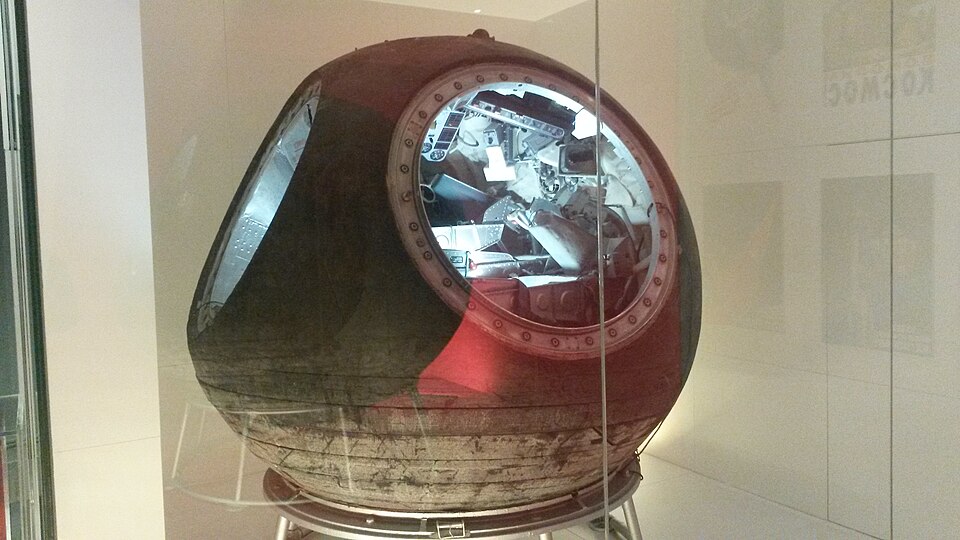
Multi-crew ship; first EVA and first physician in orbit
Voskhod in the timeline
The R-7 Semyorka, the world's first intercontinental ballistic missile, makes its maiden flight. Its descendants (Vostok, Voskhod, Soyuz) will fly for seventy years.
At Korolev's bureau, Feoktistov is a lead designer of the Vostok capsule that carries Gagarin, and then of Voskhod and Soyuz, the engineer who drew the ships. The year he moved onto the Vostok work is not established by the research behind this archive.
The day after Voskhod 1 lands, Khrushchev is ousted. The crew that flew for his prestige returns to a different Kremlin. Brezhnev's era of stagnation begins.
Korolev strips a Vostok to cram in three: a pilot, an engineer (Feoktistov) and a physician (Yegorov), flying without pressure suits. The flight lasts 1 day 17 minutes 3 seconds.
Boris Yegorov, aboard Voskhod 1, makes the first in-flight medical observations by a doctor: vestibular function, cardiovascular response, the beginnings of clinical space medicine.
Rejected in 1962 for short sight and admitted only in May 1964, Yegorov flies on Voskhod 1 with Komarov and Feoktistov, making the first medical observations of humans in orbit by a doctor.
A civilian engineer, Feoktistov talks his way onto Voskhod 1, becoming the first engineer and one of the first designers to fly in his own spacecraft.
Alexei Leonov leaves Voskhod 2 for the first-ever extravehicular activity, and nearly cannot return when his suit balloons; he bleeds off pressure to squeeze back through the airlock. Another first snatched from disaster.
Leonov floats free of Voskhod 2 for 12 minutes 9 seconds, by his own account for over ten minutes, then finds his suit so ballooned he cannot re-enter the airlock; he secretly bleeds off pressure, risking the bends, to squeeze back in.
This object is named in 4 verified source entries across 3 dossiers of this book. The entries sit with the people who built or used it, which is where the research recorded them.