Salyut
The first space stations, civil and (secretly) military
Salyut in the timeline
Yelena Kondakova trains as an engineer and joins RKK Energia; she marries cosmonaut Valery Ryumin.
Feoktistov becomes a principal designer of the Salyut stations, the orbital homes at the centre of this history. The years of that work, and any part in Mir, are not established by the research behind this archive.
To hide their military purpose, Chelomei's Almaz stations fly under the civilian Salyut designation (Salyut 2, 3, 5). Salyut 3 carries an aircraft cannon, the only armed space station ever flown.
The USSR launches the world's first space station. Denied the Moon, the Soviet programme reinvents itself around the goal that will define it for thirty years: living in orbit.
Returning from three weeks aboard Salyut 1, the crew of Dobrovolsky, Volkov and Patsayev die when a valve opens during reentry and depressurises the cabin. They are found dead in their seats, the only humans to die in space. Pressure suits are made mandatory forever after.
Aboard Salyut and Mir, the Oazis and later Svet greenhouses attempt to grow peas, wheat and other plants, the first steps toward closed-loop life support and, one day, food on a Mars ship.
The first military Almaz station, flown under the Salyut cover name, breaks up in orbit before a crew can board, the secret armed reconnaissance station programme of Chelomei's bureau.
Salyut 3 (Almaz OPS-2) carries a modified 23 mm Rikhter aircraft cannon, the only gun ever flown on a crewed station. An unmanned test firing in January 1975 is reported, but the research behind this archive does not confirm it. A crewed military reconnaissance outpost of the Cold War.
The military Almaz reconnaissance stations fly under the civilian 'Salyut' name to disguise their true purpose: high-resolution photo-reconnaissance and, on OPS-2, a cannon. Their real history stays classified for decades.
With two docking ports, Salyut 6 can be resupplied by uncrewed Progress freighters and host visiting crews, enabling the first genuinely long expeditions and the Intercosmos guest cosmonauts from allied nations.
Czechoslovak, Polish, East German, Cuban, Mongolian, Vietnamese and other guest cosmonauts visit Salyut 6 and 7, the space programme as socialist diplomacy.
The invasion ends détente and triggers the US boycott of the 1980 Moscow Olympics; the renewed Cold War shadows the Salyut and Buran programmes.
Long Salyut 6 missions reveal serious calcium loss, muscle atrophy and cardiovascular deconditioning; the countermeasures (the treadmill, the 'Penguin' loading suit, rigorous exercise) are developed in response.
Popov and Ryumin set an endurance record, deepening the medical study of long-duration weightlessness (bone loss, muscle wasting, fluid shifts) that is the real science behind the propaganda.
The first TKS flies unmanned as Kosmos 929 in 1977; Kosmos 1267 docks with Salyut 6 in 1981 and Kosmos 1443 with Salyut 7 in 1983. The crewed Almaz programme is cancelled, but Chelomei's transport spacecraft and its modules become the basis of the add-on modules for Salyut 7, Mir and eventually the ISS.
Savinykh makes his first long-duration flight, 74 days 17 hours 37 minutes, learning the routines of station life that will save him four years later.
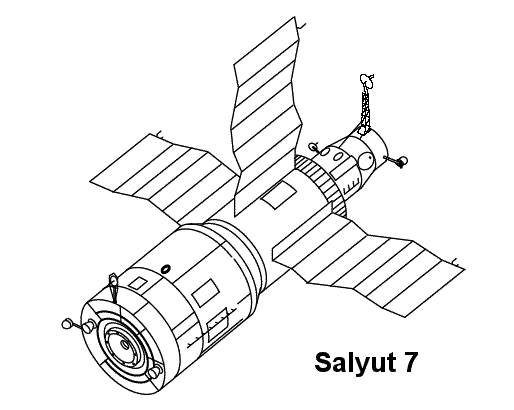
The last of the Salyut line and the immediate predecessor of Mir; it will host the first woman's spacewalk, a near-fatal fuel leak, and the astonishing 1985 rescue of a dead station.
Savitskaya flies to Salyut 7 aboard Soyuz T-7, pointedly ahead of the first American woman in space. By the often repeated story, her male crewmates offer her an apron and she declines.
This object is named in 11 verified source entries across 5 dossiers of this book. The entries sit with the people who built or used it, which is where the research recorded them.