Valentin Glushko
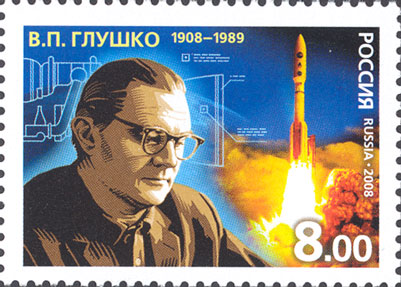
Master of the rocket engine; head of NPO Energia
Timeline - Glushko in the record
12 entries from the Secret Dawn - Among the Stars archive, 8 of them events in Glushko's own life.
Valentin Glushko is born in Odessa; the sources give 2 or 3 September 1908. He is said to have written to Tsiolkovsky as a teenager and to have dreamed of interplanetary travel.
The GDL in Petrograd, the seed of Soviet rocket-engine work; Glushko joins it in May 1929 and designs the first Soviet liquid-fuel motors there.
At the Gas Dynamics Laboratory Glushko designs the first Soviet liquid-propellant rocket motors, the start of a career as the USSR's master of the rocket engine.
Stalin's purges sweep through the aviation and rocketry institutes: Korolev, Glushko, Tupolev and countless engineers are arrested. The Soviet space programme is founded, in part, by men who first met in prison.
Denounced on testimony that included Glushko's, extracted under interrogation three months earlier while Glushko was himself in custody, Korolev is arrested and tortured, according to later accounts with a broken jaw, and after sentencing sent on to Kolyma, the Gulag's deadliest region.
Caught in the purges, Glushko is imprisoned; interrogation extracts testimony implicating Korolev. The two men will work together for decades under the shadow of that betrayal.
As the Reich collapses, Soviet and American teams race to seize V-2 hardware, blueprints and engineers. Korolev and Glushko are sent to Germany in uniform to reconstruct the missile.
Glushko's RD-107/108 engines power the R-7 that launches Sputnik and Gagarin. His combustion chambers are the heart of the Soviet space rocket. The dates of the engine development are not established by the research behind this archive.
Glushko refuses to build the huge engines Korolev wants for the N1 (disagreeing over propellants); Korolev turns to Kuznetsov instead. The split between the two greatest designers hobbles the Soviet Moon effort.
After Korolev's death and the N1's failure, Glushko is made director of the merged NPO Energia in May 1974, a post he holds until June 1977 before continuing as general designer; he cancels the N1 and redirects the bureau toward stations and, eventually, the Energia-Buran shuttle.
Glushko's Energia, the most powerful Soviet rocket, launches the Buran shuttle on its single uncrewed flight in 1988, the last great achievement before the collapse.
Glushko dies as the system he served begins to fail; a crater on the far side of the Moon bears his name.
The research file for this dossier holds 7 verified source entries, 7 of them distinct works. The sources page lists every one of them with what it covers, how it was reached, and the sharpest point at which this page and its sources come apart.