TABLIT
Таблица умножения
My own, 2026
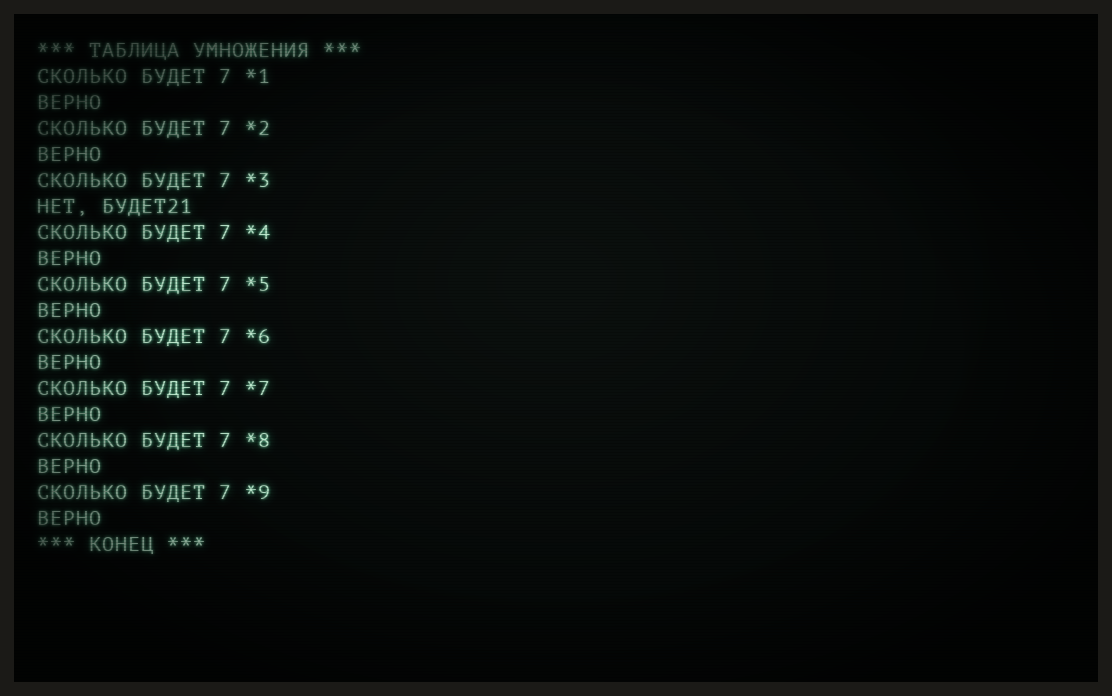
Nine rounds of the seven times table. It asks, you answer, it says ВЕРНО or tells you the right number and moves on. Thirteen lines, the shortest program on any of these disks, and the one I think most likely to have actually run in a classroom on a machine like this.
- sectors
- 20
- source lines
- 13
- rounds
- 9
Run this disk · The image, 256,256 bytes
The most plausible title in the collection
Everything actually recovered from this machine is administrative: a payroll system, and a database suite from a planning institute. That is what an Iskra-226 was bought for. So when I ask myself which of these disks could plausibly have existed in a vocational school computing room in 1988, the answer is not the starship. It is this one. A teacher writes a drill in an afternoon, the students run it, nobody keeps a copy because it is not software, it is a Tuesday. Multiplication tables are the boring, likely thing. I used to finish this paragraph by calling the Klingons the wish, and that was wrong. The people who worked on these machines remember a Klingon game on them, and Conway's «Жизнь», and a shooting game called «Марс». Not one of the three survives as a file, and mine are not copies of any of them. What goes away is only my tidy idea that the starship was the fantasy and the drill was the realistic one. Both kinds of program were written here. Neither kind was kept.
What it cost the interpreter
Thirteen lines and one FOR loop over nine rounds, which is exactly the shape that catches a bad loop. My first assumption for TO in a FOR statement was the token 2A. Line 3290 of the corpus says otherwise: the byte is D1. With 2A the parser read the construct as a multiplication, and the loop ran once and stopped, quietly, with no error at all. A nine round drill that gives you one round is impossible to miss. Reading the corpus would never have shown me this. Writing a program that had to survive its own loop did.
What this disk is not
This is not a recovered classroom disk. There is no such thing in my hands, and I want that stated plainly on the page that would be easiest to mistake for one, because TABLIT is the title here that sounds like it could be genuine. It was written in 2026 in a decoded dialect, assembled with a program I wrote, and run in an emulator. If a real Soviet school drill for this machine ever turns up, it will be somebody else's find, I will be delighted, and it will not be this.
What I checked
TABLIT nine rounds, right and wrong answers scored correctly
What this does not show
The drill runs the seven times table and nothing else, so there is no randomness in it, nothing to seed and nothing to vary between runs. What is tested is the emulator, not the hardware. Whether a surviving Iskra-226 would load this disk is the one open question left on this part of the project, and I would very much like someone to answer it.
Where to read more
- TABLIT.bas, the source Thirteen lines, the shortest thing on any of these disks, and the loop in the middle is what caught the wrong token for TO.
- The assembler Source to token bytes to a disk image, and the byte D1 that a nine-round drill running once made obvious.
- The Iskra-226 manuals The Russian documentation for this machine, including a 261-page BASIC 02 language guide and a set of guidelines for laboratory practice in computer science.
The source
TABLIT.bas, 13 lines, assembled onto the image with iskra_asm.py
13 lines of BASIC
10 REM TABLICA
20 PRINT "*** ТАБЛИЦА УМНОЖЕНИЯ ***"
30 FOR V01 = 1 TO 9
40 PRINT "СКОЛЬКО БУДЕТ 7 *";V01
50 INPUT V02
60 V03 = V01 * 7
70 IF V02 = V03 GOTO 100
80 PRINT "НЕТ, БУДЕТ";V03
90 GOTO 110
100 PRINT "ВЕРНО"
110 NEXT V01
120 PRINT "*** КОНЕЦ ***"
130 END