STIPENDIYA, the stipend payroll of SPTU-132
АВТОМАТИЗИРОВАННАЯ СИСТЕМА ПРОВЕДЕНИЯ РАСЧЕТОВ ПО ДЕНЕЖНЫМ ВЫПЛАТАМ УЧАЩИМСЯ
Five entries, sectors 24 to 812: a dispatcher, two program segments, a working variant of one of them, and a data file of 561 sectors that I have not opened. The dispatcher prints a banner with three author names, a school number and a date, and that is the first time anything in this archive said something about people.
- catalog entries
- 5, of which 4 are programs
- extent
- sectors 24 to 812, 813 of 1001 cataloged
- S0
- sectors 24 to 35, 18 lines, dispatcher
- S1
- sectors 36 to 82, 201 lines, database block
- S2
- sectors 83 to 177, 485 lines, payroll calculation
- 132
- sectors 178 to 738, data file, not decoded
- S2*
- sectors 739 to 812, variant of S2
- banner
- ВЕРСИЯ СПТУ-132 01.09.88
- authors
- Gorenburgov M. A., Vintskevich V. V., Muchkina L. V.
- dated
- 04.04.1989
Run this disk · The image, 256,256 bytes
What is on the side
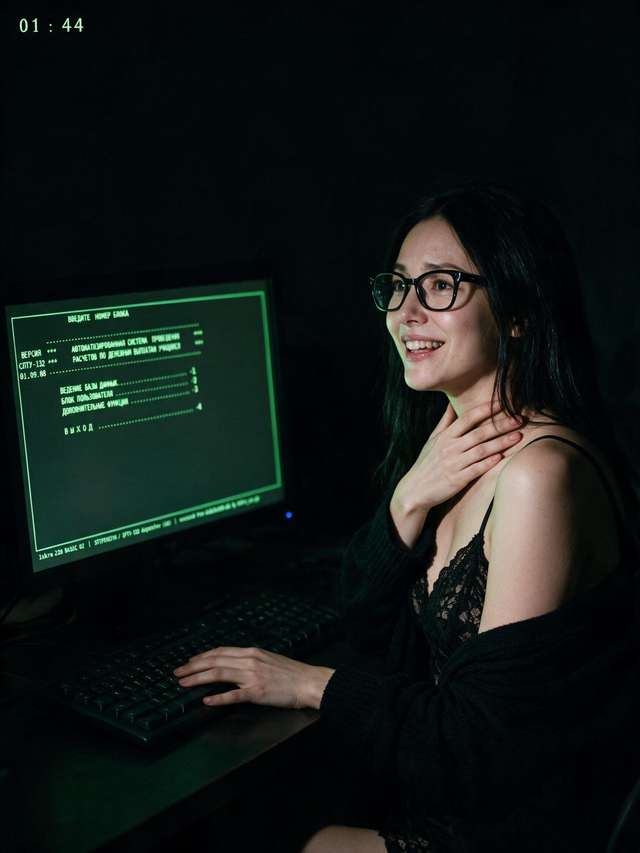
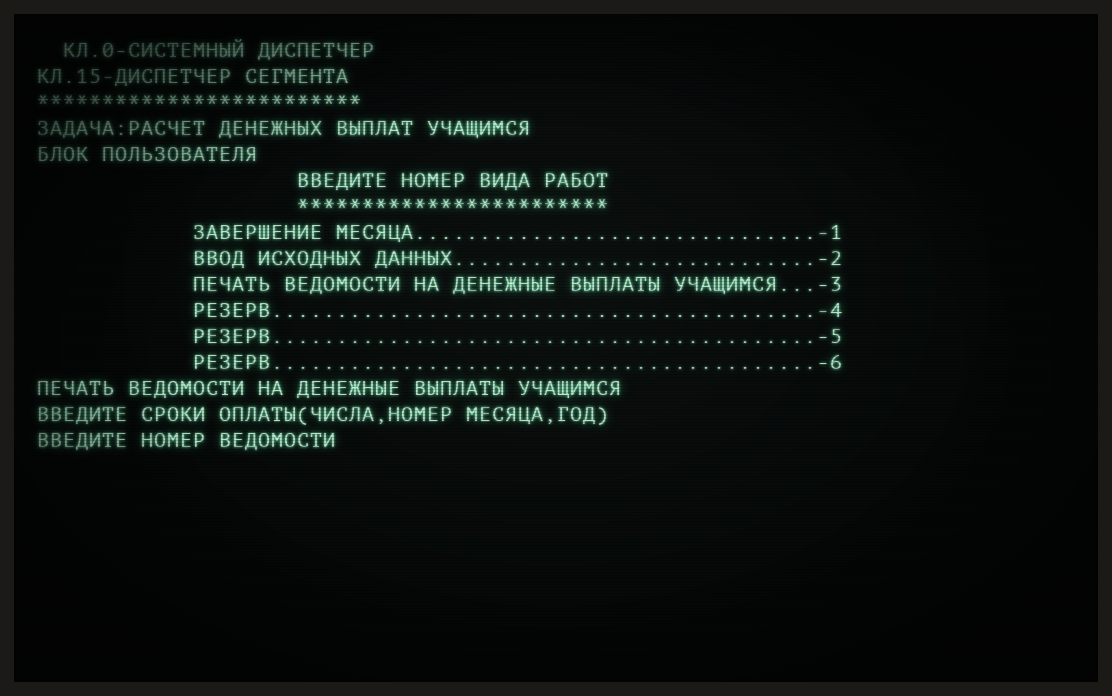
S0 is eighteen lines long and does one job: it paints a title, offers four choices, and chain-loads whichever segment you pick. The title reads АВТОМАТИЗИРОВАННАЯ СИСТЕМА ПРОВЕДЕНИЯ РАСЧЕТОВ ПО ДЕНЕЖНЫМ ВЫПЛАТАМ УЧАЩИМСЯ, an automated system for monetary payments to students, and in the top right corner, in three separate positioning statements, ВЕРСИЯ, СПТУ-132, 01.09.88. S1 at 201 lines maintains the database. S2 at 485 lines does the arithmetic. S2* is a variant kept alongside it. Between them, from sector 178 to sector 738, lies the file named 132.
Which school
The evidence points at Leningrad and stops short of proving it. There was a СПТУ № 132 in the Frunzenskiy district, founded in 1977, which trained programmers and computing center operators, and which its own successor's chronicle calls the only училище in the Soviet Union specialized in staffing a computing center. It is the Petersburg College of Information Technology today. The machine itself was a Leningrad design, the BAM suite on the other application side went through a Leningrad development stage, and the person who read these disks lives there.
What keeps this at probable is the numbering. ПТУ numbers were handed out by the republic and oblast administrations rather than centrally, so schools with the same number existed side by side across the union, and the digits 132 on their own place nothing. No document has turned up that names a school with this number and an Iskra-226 room and this software in the same sentence. Until one does, the attribution is a convergence of indications and I am going to keep calling it that.
What it computes
The payroll logic is small and completely legible. A row carries what a student earned on their practical placement and what they received as a stipend, minus deductions for canteen meals, and the difference is what gets paid out. An asterisk after a name is the software's full-month marker; without it the proportional formula applies, days worked over days in the month. The sums are between thirty and ninety roubles, on a machine that cost between eleven and twenty five thousand roubles depending on how it was configured, and every kopek of the total had to reconcile against the cash desk under two signatures. The file 132 is a student file from 1989. I have not decoded it and I am not going to.
Where the bytes come from
The archive is 880.rar, published on oldpc.su by the forum user vazman, who owned the physical disks. dk_spb read them and made the images. The thread is on phantom.sannata.org and dates from 2016. The download link is dead; the copy I work from came out of a Wayback snapshot from that year, and as far as I can establish it is the only one left anywhere. Neither of them owes me anything, and both of them are the reason any of this exists.
What I checked
All four programs load, chain and run end to end, and the arithmetic holds. On the sheet the software printed for me the rows come to 144.50 in practical wages and 105.00 in stipends, 249.50 accrued, 37.20 withheld, 212.30 to be paid out. I checked every one of those against a hand calculation before I believed them. The sheet is not a surviving document: the program is the one from 1989, the three students on it are three I typed in.
What this does not show
The school attribution is probable and not established, for the reason above. The run is a run in my emulator, at the BASIC level, and says nothing about hardware. The data file stays closed, so what the software does with real records is known only from the programs that read it, which are in the listings for anyone who wants to check my arithmetic without me publishing somebody's file.
Where to read more
- The post that put these disks online dk_spb on 24 June 2016, one line with the link and a thank you to vazman for the disks, reachable now only as a snapshot.
- 880.rar 301,403 bytes of archive holding all six sides. The address on oldpc.su has been dead for years, and this snapshot from August 2016 is the copy I work from.
- S2, the payroll calculation, decoded Four hundred and eighty-five lines as they come off the side, with S0, S1 and the variant in the same folder, so anyone can check my arithmetic without me publishing somebody's file.
- All six sides inventoried Extent, contents and a run test for every program in the set.
I wrote about this at the time